BagNews Archives About Staff BagNews is a progressive site dedicated to visual politics and the analysis of news images.
Friday, May 25, 2012
September 12, 2011

Alan Chin on “the 9/11 Decade”: Beyond Pushpins On A Calendar


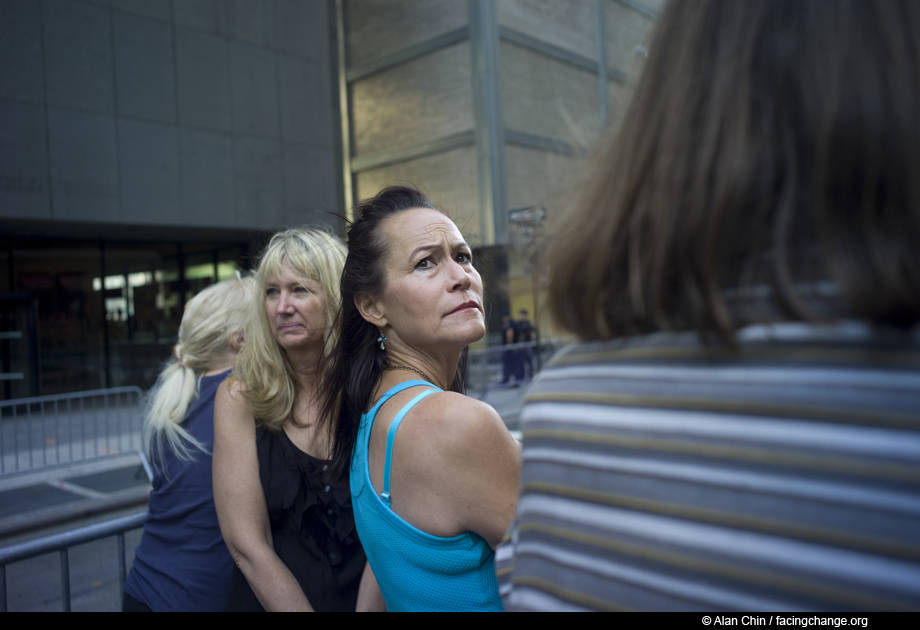
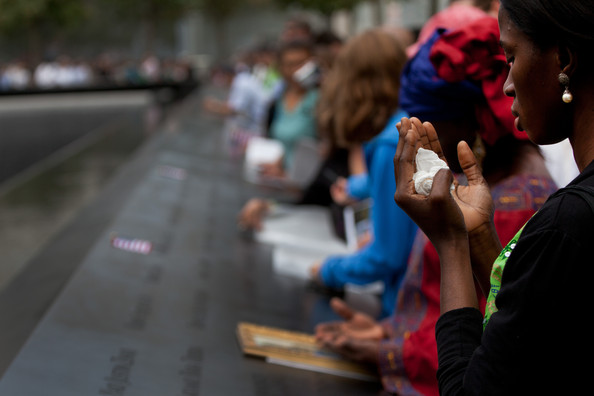
September 11th, 2011: The 10th anniversary in Lower Manhattan.

I lived on the Lower East Side, but I slept through the impacts of the planes striking the Twin Towers, and only the ringing telephone woke me up. My brother in Michigan told me the news, and as he spoke I noticed that the normal sounds of street traffic were entirely gone, in their place the wail of sirens from emergency vehicles barreling downtown at very high speed. I switched on the TV, but couldn’t get any reception except for one faint, fuzzy station; the antenna had been on top of the World Trade Center. But that was enough.
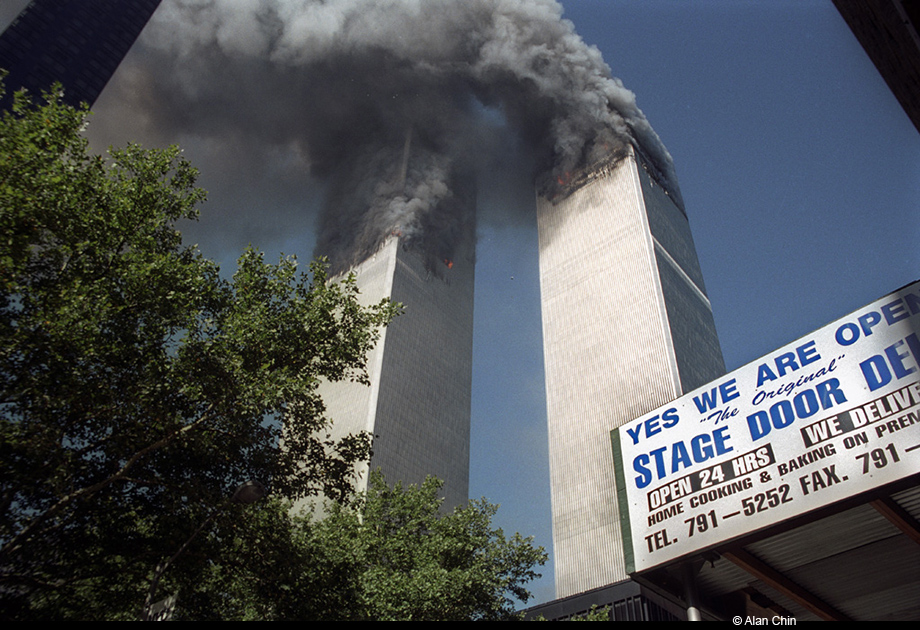

Approximately 9:50 AM, September 11, 2001, on the corner of Church and Vesey Streets.

I rushed there and shot one roll of film before the South Tower exploded and I ran with a few police officers and firefighters into the basement of an office building, thinking that the tower might fall on top of us. When we emerged, the entire world had changed. My father, who knew I had gone to the scene, told me later that he was sure I was dead, watching the explosion from the coffee shop in Chinatown where he went for breakfast.
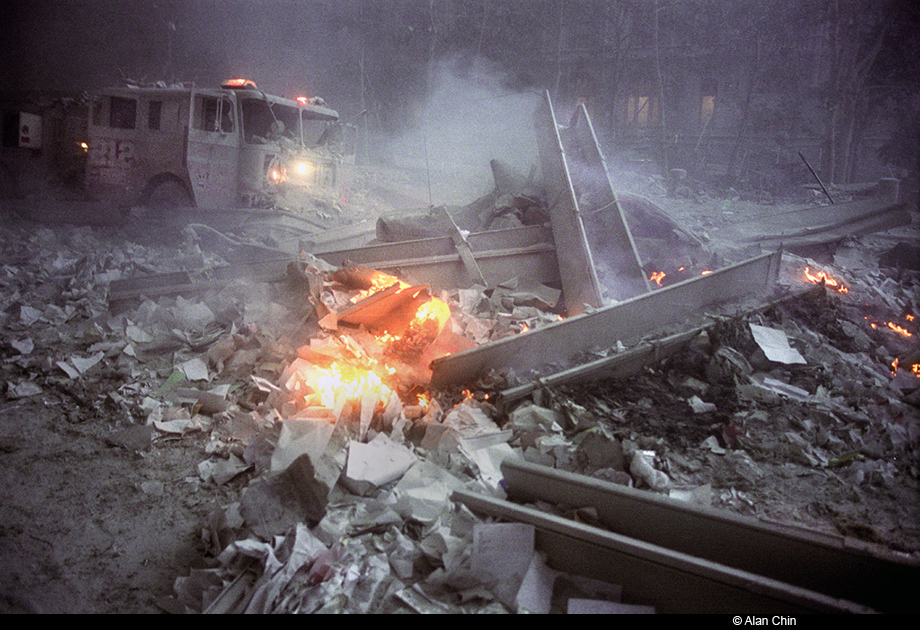

Approximately 11 AM, Broadway and Liberty Street.

Day became twilight gloom with smoke and ash, and for the next minutes and hours, I photographed on autopilot, unable to comprehend what had happened: One plane might be a horrific accident; two made no sense whatsoever.

I wasn’t the only one to revert to Cold War thinking, imagining a Soviet or Chinese pre-emptive strike even though the Soviet Union didn’t exist any more and China didn’t have the range. If World War Three was beginning, why wasn’t it nuclear, and all of us dead, or at least a steady stream of cruise missiles raining down upon the city? Only later in the day, as more details emerged, did I understand that I had just witnessed the most murderous, and hence effective, terrorist attack in history.
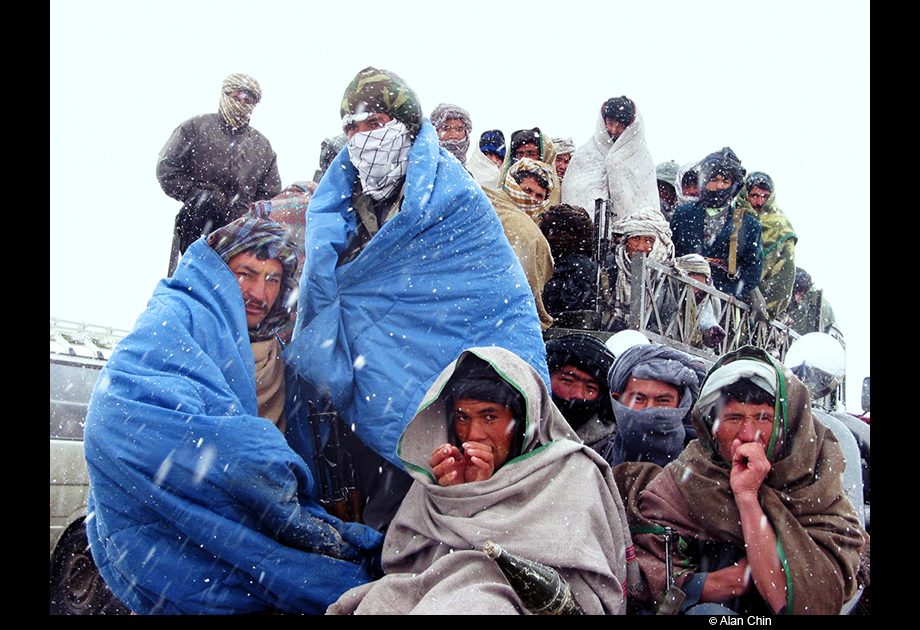

December 3, 2001: Northern Alliance soldiers wait in a snowstorm while their commanders negotiate the surrender of a group of Taliban still holding out in Balkh, Afghanistan.

Two months later, flying from JFK for Afghanistan, we could see Ground Zero still burning. It was a just war with universal outrage and support. The Uzbek navy ferried journalists across the Amu Darya River into northern Afghanistan, French paratroopers held the Mazar-i-sharif airfield, and small American teams were attached to each Northern Alliance unit. The conventional fighting was easy, and six thousand Taliban, Pakistanis and other foreigners of Al-Qaeda’s Islamist international brigade surrendered in Kunduz.
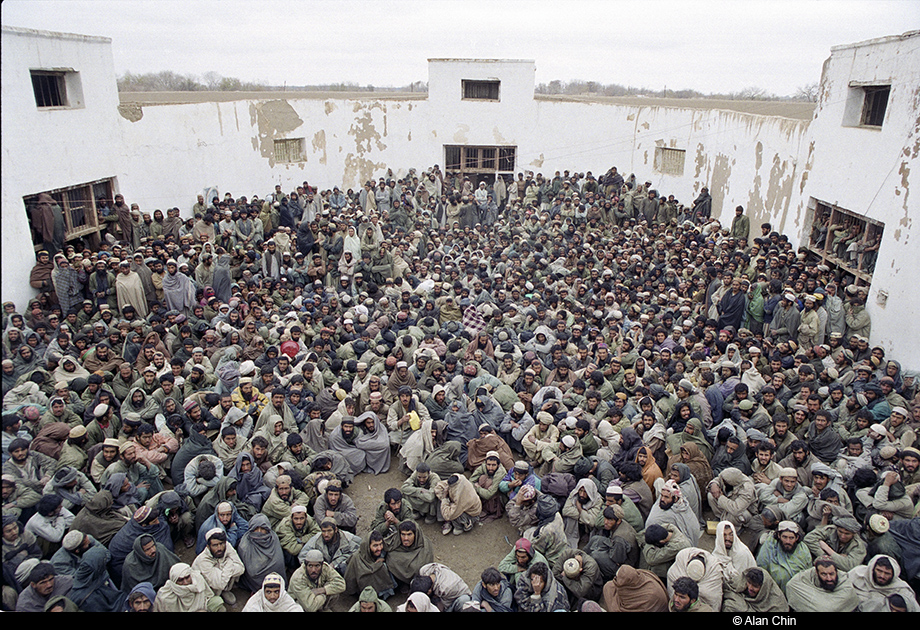
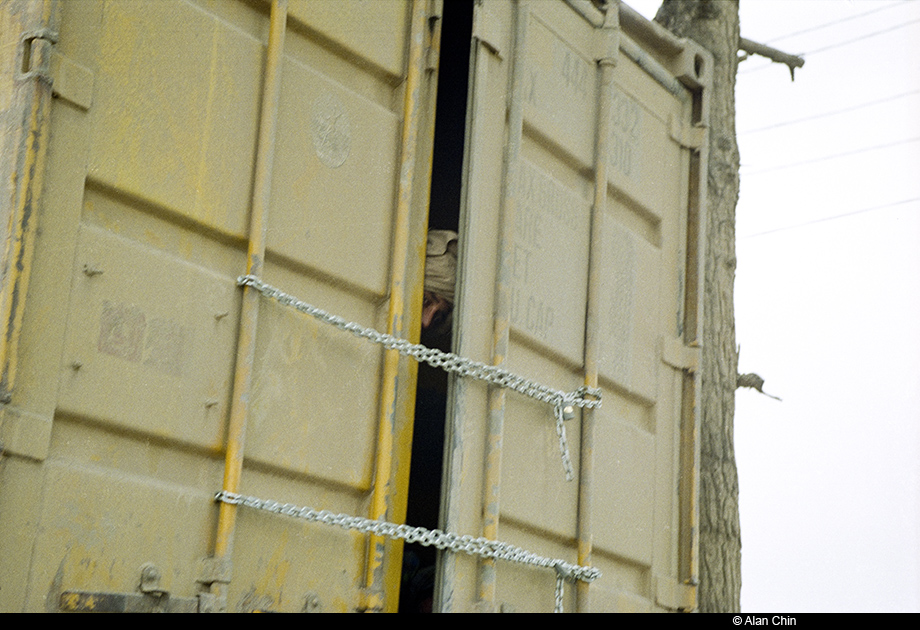

December 2, 2001: Thousands of Taliban soldiers were transported to a prison in Seberghan controlled by Northern Alliance general Abdul-Rashid Dostum. A prisoner looks out of the rear gate of a container truck as it enters the prison gates.

That was when I first began to realize that something was going seriously wrong in George W. Bush’s America, when at least a thousand of those prisoners died en route to prison, either suffocated in overcrowded trucks or helplessly massacred by vengeful Northern Alliance soldiers. The Geneva Convention was discarded, selected captives whisked away to Guantanamo Bay, and the United States was participating in or silently complicit to war crimes, under the exculpatory claim that we were fighting neither proper national states nor could our enemies then be considered simple, if arch, criminals. In that gray area, the laws of war and due process disappeared down a black hole.

But still, I could not come to those conclusions quickly. Bosnia and Rwanda had taught many of my generation to distrust pacifism and embrace humanitarian intervention. The America I grew up in had checked a previous era’s excesses by impeaching Nixon and welcoming cultural, racial, gender diversity in gradual, but meaningful ways. It was hard to believe and accept that with no evidence linking 9/11 to Saddam Hussein’s Iraq, President Bush would lead the nation into another, entirely unnecessary, war. Osama Bin Laden remained at large and the Taliban a threat.
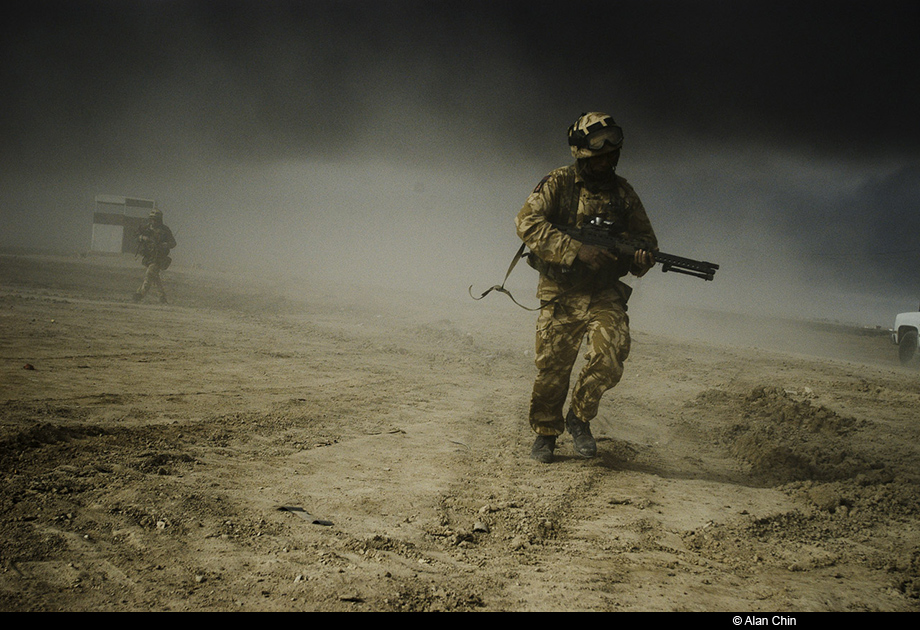

March 30, 2003: The British Army attacking Basra, Iraq’s second largest city.

In my own life, my father died suddenly of a medical error in December 2002 and for me the rush to war receded into the background, a charade of brinkmanship. But like my personal tragedy, the invasion of Iraq was brutally, unequivocally real. No amount of over-thinking analysis could wish it away. Ascribing wisdom and complexity to our leaders did not endow them with such traits. I found myself once again covering an American war, and this time the breakdown of logic was glaring and obvious from the get-go. There were no weapons of mass destruction, and if Saddam Hussein’s totalitarian regime was truly on a different order of evil and murderousness — and, it was — then the only redemption for waging aggressive war to destroy it would be to quickly and decisively establish the conditions for civil society. But that could not be a lower priority on the war plan.
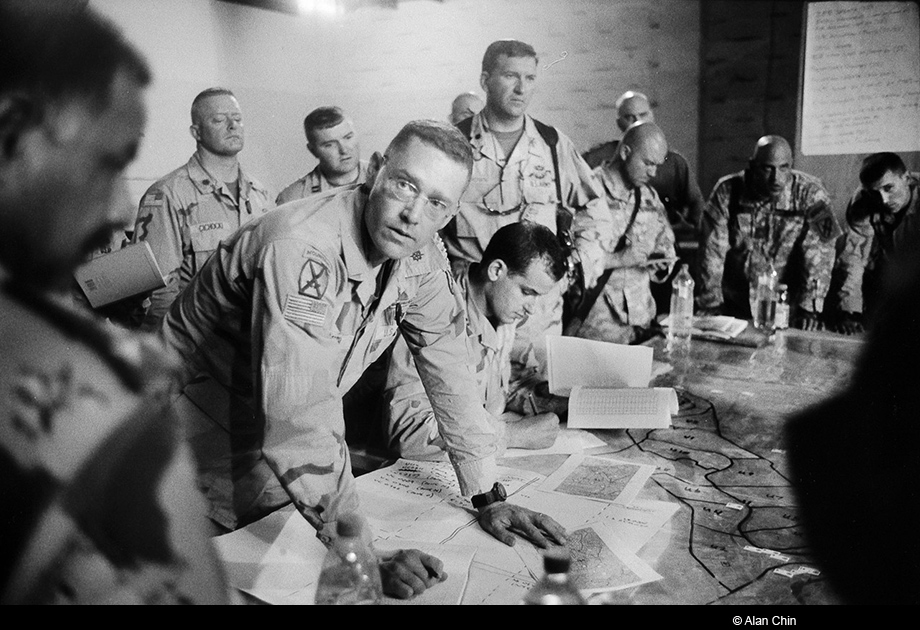

May 2005: American and Iraqi officers plan operations in the headquarters of an American brigade in Mahmudiyah south of Baghdad.
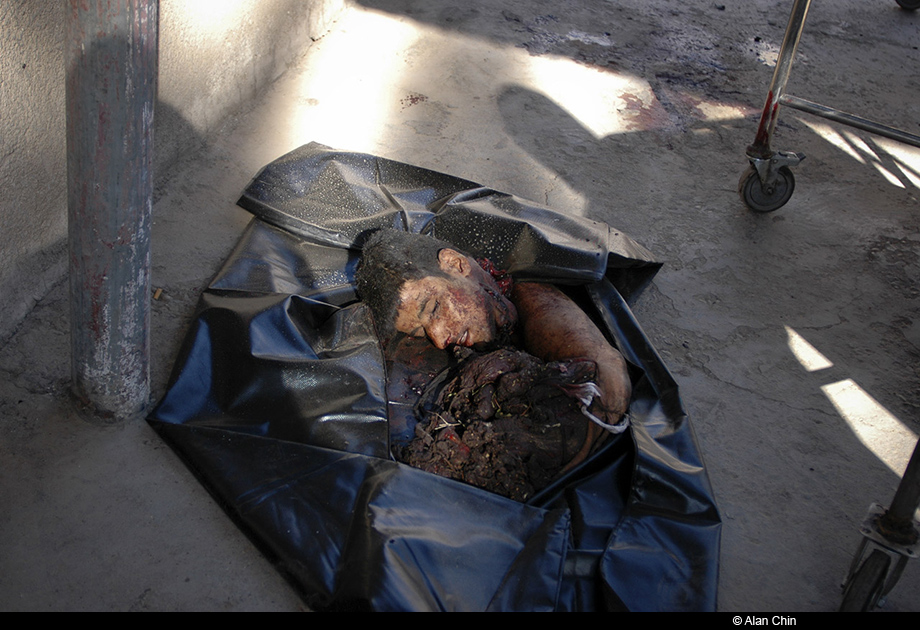

May 5, 2005: Remains of suicide bomber who killed 15 potential recruits awaiting entry to an Iraqi Army base, Baghdad, Iraq.

There is no need to repeat the litany of mistakes, miscalculations, and moral failures of America’s intervention in Iraq. On my second trip there in 2005, the sectarian civil war flared out of control with daily suicide bombings and heavy-handed American counter-insurgency in riposte. I came home and Hurricane Katrina unfolded from a terrible natural disaster into a collapsed response, starting with the incompetence of coping with the tens of thousands of survivors at the Superdome, and continuing through the protracted ordeal of FEMA trailer parks and a major American city still not entirely restored six years later.
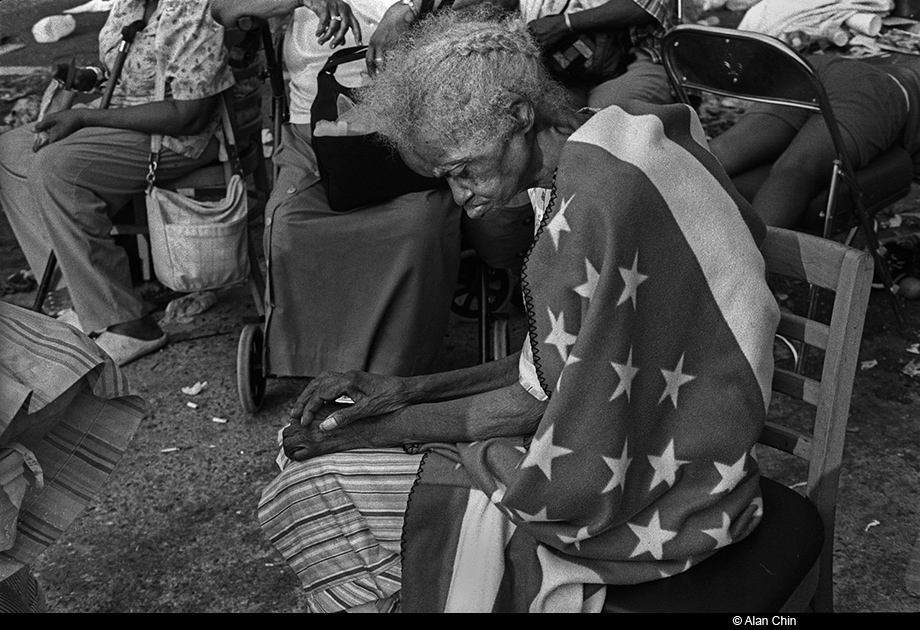

September 3, 2005: Hurricane Katrina, New Orleans. 84-year old Milvertha Hendricks wrapped in an American flag blanket after spending five days on the street at the Convention Center. She was not evacuated until the next day.

The same cultural and political attributes that led to quagmire in Afghanistan and Iraq were on display domestically in Louisiana. What I thought were much vaunted and celebrated American virtues of the can-do spirit, practicality, and civic idealism – virtues tarnished but not, I thought, vanquished by Vietnam or perennially cynical evocations of decline — turned out to be corroded and hollow indeed. Fear mongering, an exaggerated sense of entitlement, nativism, and naked partisan lust dominate the discourse, and the soaring idealism of the Obama campaign and presidency have turned out to be brittle and shallow in practice.
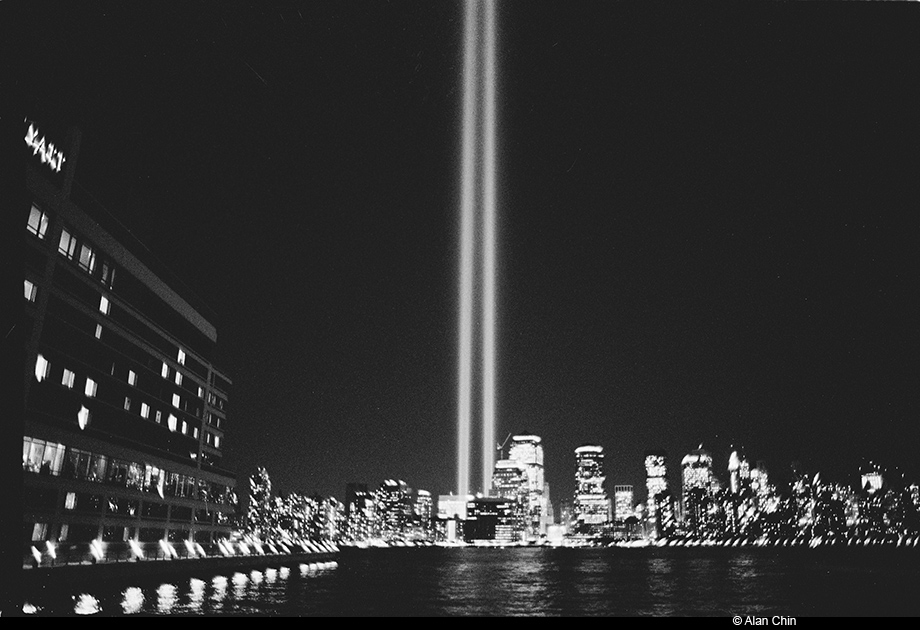

September 11, 2004: The Towers of Light memorial as seen from Jersey City, New Jersey.

Each September 11th at Ground Zero in Lower Manhattan, the ceremony expressing the heartfelt emotion of New Yorkers in mourning slowly became overshadowed by the World Trade Center site as a stage for chest-thumping and jingoistic expressions of nationalist excess. Last year, something that should never have become controversial became a contentious circus over the proposed construction of the Park 51 Islamic center. This devolution has been heartbreaking.
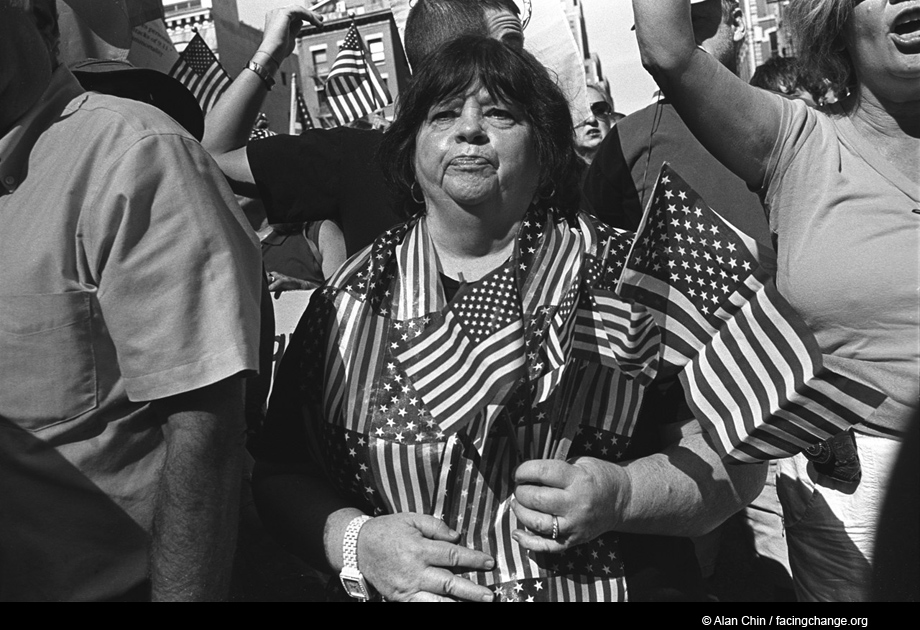

September 11, 2010: A crowd of several thousand right-wing protestors gathered against the planned Islamic Cultural Center on Park Place.

This year, the people of New York were encouraged to stay away. A massive security operation closed off much of Lower Manhattan. President Obama spoke, but essentially only to television cameras. In a different America, a million people might have come out to hear him and memorialize our dead, regardless of politics, class, or any other points of identification. Unity, contemplation, and grief are crucially appropriate at such a moment. Instead, the atmosphere was subdued in the extreme, with only tourists, the usual 9/11 conspiracy theorists, and local residents going about their daily business apart from the uniformed services and the families of the victims. Reserving the prime focus for their quiet and somber pain is absolutely right. We do some things well. But caving in to the fear of another attack, and allowing this universal tragedy to be appropriated by poisonous culture war speaks volumes to the cowardly and darker sides of the American character.
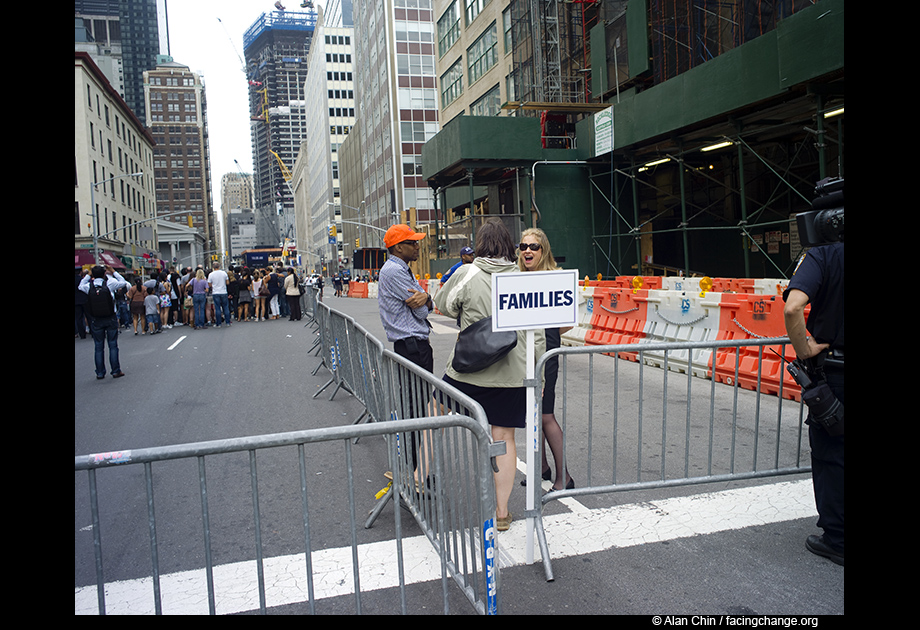

September 11th, 2011: The 10th anniversary in Lower Manhattan.

Though anniversaries may just be pushpins on a calendar, they are key markers of our individual and collective lives. The tenth has particular meaning by the measures through which we assess aging and change. My mother passed away several days ago after a long, terrible illness. I was thirty years old in 2001, I am forty now, and for me, September 11 will forever be book-ended by my parents: my father’s trepidation for me when he, unknowingly, had not long to live, and my mother’s death this past week. They may not be directly connected, but each of our experiences is entwined with the greater society to which we all belong.

The American Dream was not killed on September 11, 2001. As many said at the time, it was an opportunity, tragic and momentous, for the finer aspirations of American idealism to reemerge with passionate exceptionalism. Ten years later, those hopes lie shattered in the dust not of the towers, but of water-boarding, Predator drones, kill teams, rendition, and a national security state.
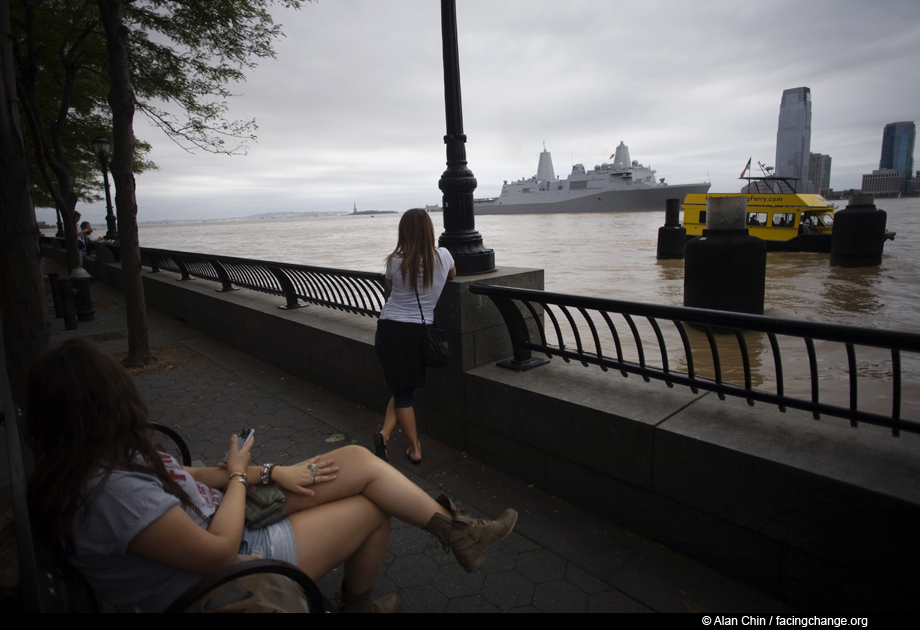
September 11, 2011: The USS New York, an amphibious assault ship built partially with the steel from the destroyed World Trade Center, anchored in the Hudson River next to Ground Zero.

–Alan Chin

PHOTOGRAPHS by ALAN CHIN / facingchange.org

Minor text edit at 1318 EST, Sept. 12 2011

  • Pingback: Worth a read: Alan Chin on the 9/11 decade | dvafoto

  • Linda

    The single most poignant take on the demise of the America my “Holocaust-surviving” Mother weeps for. And as her daughter, that I fight for everyday to try and regain. That lost ground, not “Ground Zero,” but the very ground of justice and liberty that was stolen from us by Bush, Cheney, Rumsfeld, Rice, Powell and Wolfowitz; but most egregiously in some sense the coporate media shills.

    Everywhere I look, every comment I read on any given news site, be it Progressive or otherwise shows all too clearly the successful division of this UNITED STATES into an aggressive, mean-spirited, hate filled, fearful Narion state in which each individual now finds no solace in the brotherhood of man, but rather a sincerely aggrandized sense of self-righteousness that is abhorrent.

    Thank you for this. Thank you very very much.

    Please America, COME BACK TO YOUR SENSES.

  • LanceThruster

    Quite a thoughtful piece except this seemingly casual dismissal is quite arguably at the heart of the problem -

    Instead, the atmosphere was subdued in the extreme, with only tourists, the usual 9/11 conspiracy theorists, and local residents going about their daily business

    So many of the
    things that disappointed you were based on the unwillingness to demand full,
    open and transparent investigations of the attack, the crime scene forensics,
    and the apparent response failures. Anyone not in lockstep with the coming
    “payback” was a traitor, and anyone questioning the official
    narrative was a nutter. That the people so readily dismissing the skeptics, did
    not heed to call themselves to demand what the commission itself determined;
    that a proper investigation was needed to uncover the truth.

    Remember,
    the alternate explanation to deride conspiracy, was the supposedly comforting
    notion that incompetence, an unrelated type of criminality (the destruction of
    evidence), the desire to cover your butt, and a string of bad luck and/or
    remarkable coincidence, explained the seeming contradictions and tat the right
    enemy had been targeted anyway, so no time to navel gaze as we needed to get
    our bloodbath up and running.

    My
    recollection is somewhat shorter as to what I saw and what we lost. I live in
    So Cal and commute to downtown LA, and have for over 20+ years. For *exactly* a
    day and a half (the same amount of time the air stays smog free after a good
    rain), the normally selfish and inattentive motorists drove in manner virtually
    unseen before or since. Over that two day period, they actually showed noticeable
    consideration and no longer drove oblivious to those around them, not caring
    who they cut off or didn’t let in or honked at for going too slow, or not getting
    out of the way fast enough…they treated the other drivers as fellow Americans
    that were also possibly traumatized or numb and that the default position might
    be that they would appreciate a random act of kindness from a stranger who
    might just cut another person a break for no other reason than they thought the
    anonymous person could use one.

    And then, as
    if it never happened in the first place, it was over. That was how long it took
    to revert back to type, and embrace dysfunction as normalcy.

    And that’s
    how we got to where we are today.

    There are
    some things in life that we can’t turn back the clock on, but tragically that
    is true even on those things we could turn back the clock on. We’re just not
    that smart or that caring, and I don’t think it’s overly pessimistic to say
    that we never will be.

  • LanceThruster

    Quite a thoughtful piece except this seemingly casual dismissal is quite arguably at the heart of the problem -

    Instead, the atmosphere was subdued in the extreme, with only tourists, the usual 9/11 conspiracy theorists, and local residents going about their daily business

    So many of the
    things that disappointed you were based on the unwillingness to demand full,
    open and transparent investigations of the attack, the crime scene forensics,
    and the apparent response failures. Anyone not in lockstep with the coming
    “payback” was a traitor, and anyone questioning the official
    narrative was a nutter. That the people so readily dismissing the skeptics, did
    not heed to call themselves to demand what the commission itself determined;
    that a proper investigation was needed to uncover the truth.

    Remember,
    the alternate explanation to deride conspiracy, was the supposedly comforting
    notion that incompetence, an unrelated type of criminality (the destruction of
    evidence), the desire to cover your butt, and a string of bad luck and/or
    remarkable coincidence, explained the seeming contradictions and tat the right
    enemy had been targeted anyway, so no time to navel gaze as we needed to get
    our bloodbath up and running.

    My
    recollection is somewhat shorter as to what I saw and what we lost. I live in
    So Cal and commute to downtown LA, and have for over 20+ years. For *exactly* a
    day and a half (the same amount of time the air stays smog free after a good
    rain), the normally selfish and inattentive motorists drove in manner virtually
    unseen before or since. Over that two day period, they actually showed noticeable
    consideration and no longer drove oblivious to those around them, not caring
    who they cut off or didn’t let in or honked at for going too slow, or not getting
    out of the way fast enough…they treated the other drivers as fellow Americans
    that were also possibly traumatized or numb and that the default position might
    be that they would appreciate a random act of kindness from a stranger who
    might just cut another person a break for no other reason than they thought the
    anonymous person could use one.

    And then, as
    if it never happened in the first place, it was over. That was how long it took
    to revert back to type, and embrace dysfunction as normalcy.

    And that’s
    how we got to where we are today.

    There are
    some things in life that we can’t turn back the clock on, but tragically that
    is true even on those things we could turn back the clock on. We’re just not
    that smart or that caring, and I don’t think it’s overly pessimistic to say
    that we never will be.

    • Alan Chin

      Thank you for your considered and thoughtful response. Your description of the drivers of LA is telling. However, at the finer points in our history, we were smart and caring: It was smart and caring to rebuild Europe properly after WW II (it was good business, too, but so would getting it right in Afghanistan and Iraq), it was smart and caring to use the postwar boom profits to build infrastructure, endow schools, and create social safety nets that have benefited the majority of Americans, and it was smart and caring to vote for the party that traditionally safeguarded and advanced these priorities in 2008 — only to see that victory get wasted. So the failures of both the Bush and Obama administrations have been entirely avoidable. To believe that they were not, that they were inevitable because of some deeper failure of all people or American people, IS overly pessimistic. History never ends, and America has always been the country of second chances. We need to give ourselves one rather desperately at the moment.

  • Pingback: Tuesday 13 September 2011

  • LanceThruster

    Thank you for your observations. The Marshall Plan* was indeed the right thing to do, though it was less “democracy at the point of a bayonet” that we’re seeing now but more of a “winning hearts and minds” of the vanquished with the goal being that reconstruction and recovery would make them less susceptible to Soviet domination.

    The Congress rubber stamped Bush’s blank check for warfare, and touted the metrics of the public works projects for Iraq and Afghanistan regardless of validity and cost effectiveness as we continued to kill for their own good. Obama has continued on this path while going along with a Congress unwilling to concede the need for American recovery to to be made a priority. We have things that need to be done, and people that need work, but the leadership makes a great show of rearranging the deck chairs on the Titanic.

    Any community with a homeless, unemployed and underemployed population should look like Main Street, Disneyland. Neighborhood clean-up crews should be moving from block to block like ants. Create departments to bond American workers on a city, state, and national level so that even small jobs and tasks could have the human resources allocated. Use the slow period to grow public transportation. Allow vets and disabled to travel free, expanding route coverage for both commuter and recreational uses. Life’s too short to cry about what we can’t be doing. Redirect funds used to kill other people for uses that would extend those benefits to all.

    Military spending is largely an economic dead-end (not a big market for used aircraft carriers and such). Invest in civilian projects and the American workforce. Even our National Guard’s resources are spread thin during natural disaters and other emergencies. Cut corporate welfare and foreign aid to aggressor nations such as Israel. Allow America to lead again by example instead of pretending its hypocrisy is not readily apparent to the rest of the world.

    Show we can lead by cleaning our own house and reopening investigations of 9/11 from physical evidence, departmental actions, and intel assessments. Pursue war crimes prosecutions for government officials as needed. End government contracts for those companies who have committed fraud and prosecute accordingly.

    Educate the US populace to the fact that a strong middle class means a strengthened America for all. Less focus on the mythical “job creators” and more on the people willing to work collectively to better the nation. Make arguments simple enough to understand, but also use facts and remain faithful to the truth. Make congress do their own taxes, and publically check their work. Make perpetrators of crimes and business meltdowns, environmental, and other fiascos have their taxes raised. For damage down on a larger scale, make the tax penalty for family members too. Same sort of graduated tax scale  (or safety net and retirement accounts) for other selected categories as a disincentive. Return the educational/vocational system to one available to all and affordable by all.

    The sooner the better. We’ve already strayed too far off the path and time’s a-wastin’. General prosperity is NOT a redistribution of wealth, but rather mutual dependence and benefit that gives us all a stake in the outcome. A rising tide does lift all boats provided we find a way to make sure everyone can acquire a watercraft of some sort.

    * The Marshall Plan (officially the European Recovery Program, ERP) was the large-scale American program to aid Europe where the United States gave monetary support to help rebuild European economies after the end of World War II in order to combat the spread of Soviet communism.[1] The plan was in operation for four years beginning in April 1948. The goals of the United States were to rebuild a war-devastated region, remove trade barriers, modernize industry, and make Europe prosperous again – link: http://en.wikipedia.org/wiki/Marshall_Plan