BagNews Archives About Staff BagNews is a progressive site dedicated to visual politics and the analysis of news images.
Monday, February 13, 2012

Twitter

@bagnewsnotes »
Advertisement


April 1, 2010

Shoe on the Other Foot

Squatters Camp SA.jpg

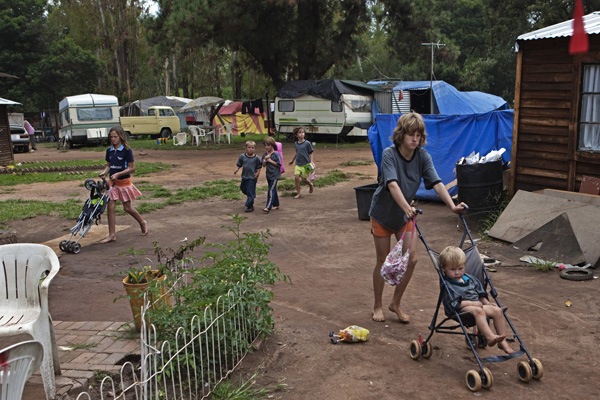
The photo plays with your assumptions once you know the context. Where do you think this is set, and what do you think you are looking at? (Detail after the jump…)

The photo shows a squatter camp for poor white South Africans in Krugersdorp.

In the post by Reuters photographer Finbarr O’Reilly, you’ll see — with the impact of black affirmative action and the slumping economy — that poor whites aren’t faring that well. Although there are over 2,000 black squatter camps in South Africa, the number of whites in the 80 camps around the capital experiencing what is sometimes called “reverse apartheid” represent a growing, if largely undiscussed problem in the country.

Reuters post. O’Reilly slideshow.

  • Mum

    Well, that’s a false equivalency for you. “Reverse spartheid”? Hardly. It’s tragic that so many people have been forced by the poor economic situation and/or the economic policies of their leaders to live in squatter camps, but it isn’t a legally-sanctioned and enforced system of oppression on the basis of race, is it?

  • http://www.doves2day.blogspot.com g

    From the article: the park was used by the British as a concentration camp for Afrikaners during the Anglo-Boer war
    Wow.

  • bystander

    Studying the picture before I made the jump, I decided it looked like a KOA Campground somewhere in the southern US (southern because it’s a little early for shorts much north of Atlanta, GA).
    From the article…

    Under apartheid, introduced in 1948, whites enjoyed vast protection and sheltered employment. The weakest and least educated whites were protected by the civil service and state-owned industries operating as job-creation schemes, guaranteeing even the poorest whites a home and livelihood. [...] But with that economic safety net now gone, South Africa’s unskilled whites find themselves on the wrong side of history, gaining little sympathy from those who perceive them as having profited unfairly during the brutal apartheid years.

    However…

    Trade union Solidarity says there are around 430,000 whites who live in squatter camps. Around the capital Pretoria alone there are 80 squatter settlements. There are over 2,000 much larger black squatter camps across South Africa.

    Acquired skill levels aren’t the only issue. Capitalism, as it is currently practiced in the US – and, increasingly, in developing countries – is a zero sum game. As one professor put it to me, Under capitalism, it’s not supposed to be nice to be poor. And, it certainly isn’t. Until we (collectively) come to understand the nature of the capitalism we are willing to practice – willing, as in, as long as we’re on the preferred side of it – we are also willing to consign broad swaths of the earth’s people to this kind of life.
    Notions of “reverse apartheid” (here in the US as well as S. Africa) are what our elite would promote and support in lieu of the understanding that they gain enormously on the backs of the poor (regardless of skin color) who serve as both warning and threat to the rest of us who still have our heads above water.

  • Maggie Jochild

    Bystander, brilliant comment. Thank you for getting to the heart of it.

  • http://motherrr.blogspot.com mcmama

    I agree.

  • Nemo

    I was in Pretoria in December 2009. There were white men at the stoplights with signs written in Afrikaans. When I asked the driver what the signs read, he told me the sign was asking for work, food and a place to stay.
    What we must realise is that Capitalism uses both blacks and whites in a disposable manner. For years, the whites having a preferred place were shielded from this. In South Africa, and in the US, this shield is gone.

  • http://profile.typepad.com/6p0120a583f7c3970b Serr8d

    Aw, you’re so cute when you gloat.

  • tinwoman

    I thought it was one of those crappy little trailer parks in the midwest, where a lot of the militia members come from.
    My in-laws from Germany were shocked speechless when they saw how some people live in America. They had no idea that level of poverty existed in the Great U.S.A. Some places in Germany, esp. the former DDR, are kind of grotty. But they don’t have slums and rural trailer park poverty the way America has.
    I have friends in Germany who have been unemployed for some time. They have health care, are allowed to stay in their apartments, and receive a stipend for the kids. They get a card to use the public transportation. Poverty in Europe is unpleasant, but doable. And you don’t fall so far down you can never get out. In the States, it’s the end of the line.
    South Africa, I can’t say. I know it’s miserable there these days. But what place in Africa isn”t?

  • guest

    Also, to call it “reverse apartheid” sort of ignores the fact that there have *always* been poor whites in South Africa. It makes it sound like this is some kind of post-apartheid phenom. It’s not at all. Desperately poor whites have lived in SA just as they have in the American South, for generations. Both groups tend to have a “well, at least I’m not black” sort of reasoning. But really, this isn’t a “reverse apartheid” at all. The SA economy generally is in the dumps. That’s all.

  • guest

    Bystander, that was true of uneducated Brits in SA, maybe. It wasn’t true for other whites…Boers for example. Some of these people have been poor whites living in the bush for a couple of hundred years. There have been, and are, distinct classes within white society in SA. Brits at the top, followed by people of other European descent, with Boers at the bottom.
    So this picture doesn’t represent a new reality for many white South Africans.

  • jan

    There at the left of the picture is that ubiquitous, white plastic chair! Where there is low income, there is always that chair! It is becoming the planet’s icon for decline.

  • http://www.futurebird.com dogcat

    Too slender to be American. Maybe 20 years ago, but not today. The poor remain malnourished in the US, but they are large, obesity representing a different kind of poverty induced malnourishment. I knew this was not in the US. The bare feet made me think “Zola Budd” she ran without shoes becuase she never had them as a child. She was hated and called a racist when she grew up poor. This is nothing new. In no way is it caused by apartheid ending.

  • http://africasacountry.com Sean

    Hi Bag,
    Thanks for the post.
    Problem with this Reuters post is that Reuters seem to go back to this camping site to prove its case that there is a crisis of white poverty. Last year before South Africa’s elections, they did a report from the same site. In fact, we see the same group of white people.
    It’s become common for foreign journalists going to South Africa to find poor whites and contrast these with the wealth of the small, black “middle” class.
    The numbers don’t add up.
    Poor whites don’t even make up 5% of the poor. Contrast that to more than 60% of blacks. And as The Economist reported last week, the claims of black control of the economy is exaggerated:
    http://www.economist.com/world/middle-east/displaystory.cfm?story_id=15824024
    See here for my take on this kind of reporting:
    http://africasacountry.com/2010/02/16/the-poor-white-problem/
    http://africasacountry.com/2010/04/05/eugene-terreblanche-is-dead/

  • http://yahoo Julian Murray

    Having been brought up in South Africa during the apartheid years and seeing us whites enjoy a prosperous life I often wondered then whether the situation would ever be reversed. I just want say sorry, please forgive me from the bottom of my heart if I was instrumental in the destruction and misery of millions of precious souls.When I see so many poor and destitute people from all races my eyes are full of tears. Please God forgive me. My prayers are daily for the people of South Africa especially the children.
    I hope Jesus soon will rule this world.
    God Bless,
    Julian Murray
    London, UK.