BagNews Archives About Staff BagNews is a progressive site dedicated to visual politics and the analysis of news images.
Sunday, May 19, 2013

Twitter

@bagnewsnotes »
Advertisement

April 6, 2009

Dover +18

Dover 1.jpg

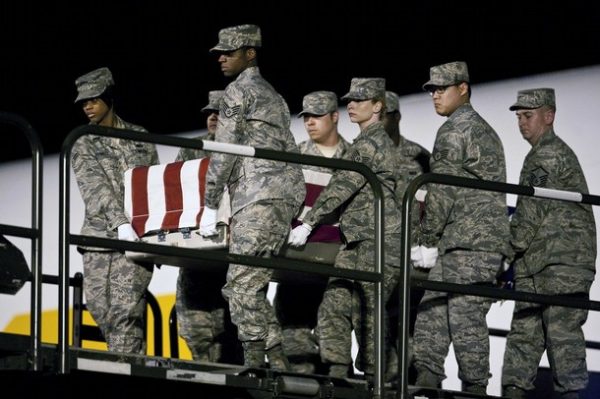
It may be incidental that the first soldier to break the news ban died in Afghanistan (as to opposed to Iraq), but it makes a huge difference in the way I look at this picture.

If it was an Iraq fatality, the significance of this scene — with the Iraq War on the downswing — would be mostly after the fact. Given our engagement in Afghanistan is ramping up, however, the casket actually warns of more to come, and offers a visual boost to the profile of an otherwise “back page” war.

And then, is there some resonance here between the two young African-American soldiers leading the casket — a woman and a man — and images of the President and the First Lady this week embarking for and disembarking in various capitals on Obama’s first Europe trip — especially in light of the violent protests over Iraq and Afghanistan at the NATO summit Obama just concluded in Strasbourg?
Dover soldier 2.jpg

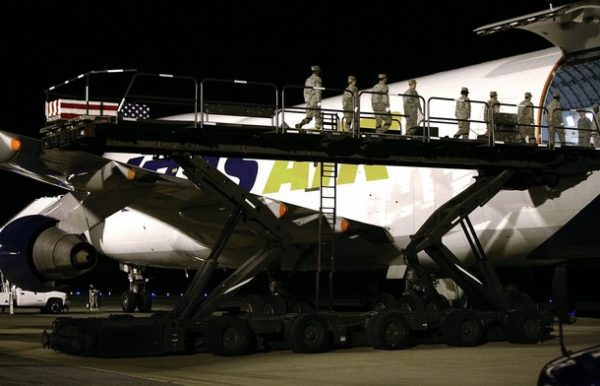
Of course, this second image is notable for two extremely strong elements not completely independent of one another. The first — reflecting the outsized scale of America’s military complex — is the enormity of that plane. The other, of course, is how solitary that casket looks as the soldiers walk away.

(image 1: Joshua Roberts/Reuters. caption: Members of the U.S. Air Force carry team prepare to off load a flag-draped transfer case holding the remains of Air Force Staff Sgt. Phillip Meyers of Hopewell, Va. during an arrival ceremony at Dover Air Force Base, April 5, 2009 in Dover, Delaware. Staff Sgt. Phillip Meyers was killed on April 4 by an improvised explosive device in Afghanistan. A new policy that overturns an 18-year ban on news coverage of returning war dead gives families a choice of whether to admit the media to ceremonies at the Air Force Base.image 2: Mark Wilson/Getty Images.)

  • Antonio

    The least one can say: It’s only proper.
    What is missing: The American President at one of these funerals.

  • http://profile.typepad.com/bmacseoin bkm242

    A minor detail, but these things are important. SSgt Phillip Myers was an airman, not a soldier. (The Reuters caption misspelled his name.)

  • Antonio

    The “contraband” image of rows of coffins draped in the US flag, all inside of an airplane, has remained with me for years.
    I do not express a unique insight when I say that the lack of access to all kinds of information about the cost of the wars, particularly visual information, has enabled our leaders to carry out policies offensive to human decency and has enabled us as a whole to go on about our lives without any sense of responsibility. At the very least, the rules and practices of both the government and the media and our compliance have permitted these policies to continue far longer than they would have otherwise.
    So, I would like to thank the Myers family of W.Va. for allowing these photographs to become public.

  • Antonio

    Of Virginia, pardon.

  • http://profile.typepad.com/johntanton jtfromBC

    Obama’s alliteration war: “to disrupt, dismantle, and defeat al Qaeda in Pakistan and Afghanistan’
    and so on ‘ January 6, 2006 – Gunnery Sgt. Philip Myers, a 14-year veteran who also served in Iraq, added Marines in his unit “are ready to go.”
    Myers, a 1991 Campbell High School graduate, said, “They want to go and handle business.”
    His wife, Sandra, said she does not see any difference in her husband’s current deployment. “To me it’s all the same,” she said. “They are both in the danger zone, regardless if it is in Iraq or Afghanistan.”
    She said they have spent a “lot of family time together” with their 6-year-old daughter, Kiana, before he leaves this morning.
    “We want him to know that we love him very much,” she said. “I am proud of what he does. … I support him 100 percent. All I pray for is that he stays alert and stays safe.”
    http://archives.starbulletin.com/2006/01/06/news/story10.html

  • http://profile.typepad.com/vcInCA vcInCA

    the fact that they’re unloading these in the dark, but artificially lit up is also interesting. As if, those who staged this are still not quite ready to bring this into the public eye, and the only way they can subvert the process is to control the time of day the ‘unveiling’ happens. as well, and totally contrary to what i just said, the darkness can be seen both metaphorically as a reminder that, for this soldier, the future is only darkness, and more symbolically, as a comfort zone, with the idea that darkness is a soldiers friend.

  • DanM

    It’s disheartening to say that these military personnel strike me as all-too-used to making that walk along the plank.
    I’m definitely not suggesting that they dishonor the dead, just that the photos show them moving without the public pomp and circumstance cadence. that makes it appear to be another delivery of another box offloaded.

  • http://profile.typepad.com/bmacseoin bkm242

    Just to clarify: the Marine Corps Gunnery Sgt Philip Myers in the Star Bulletin story is not the Air Force SSgt Phillip Myers who was killed in Afghanistan. SSgt Phillip Myers was an Air Force Explosive Ordnance Disposal (EOD) specialist assigned to the 48th Civil Engineer Squadron at RAF Lakenheath, England. I went to high school at Lakenheath and was stationed just down the road at RAF Mildenhall for many years.

  • http://profile.typepad.com/bmacseoin bkm242

    The mortuary affairs unit at Dover AFB, Delaware conduct “dignified transfer” of remains 24 hours a day. The transfer is conducted when the remains arrive at Dover. SSgt Myers’ remains arrived at 9:19 pm from Ramstein AB in Germany. If the remains had arrived at 9:19 a.m. the transfer would have taken place in broad daylight.

  • http://profile.typepad.com/johntanton jtfromBC

    interesting comments vcInCA
    Canadian soldiers seem to get killed in 2, 3, or 4’s by IED’s, an official Ramp Ceremony is held and filmed in Afghanistan followed by National TV coverage on their return to Canada. I know of no family objecting to this tradition.
    I assume there will be multiple coffins of US service personnel, what happens if half the families or just one person doesn’t give permission, will the press be asked to leave, or do you think the majority of American families will be supportive of a return to the Dover program ? Only time will tell if night time arrivals become a SOP.

  • http://profile.typepad.com/vcInCA vcInCA

    OK, there appears to be a very valid reason why its dark, but still, when interpreting a picture, given that the public is seeing their first images of remains being transferred after dark, things like this (coincidences) can have an impact on how the image is interpreted more broadly. isn’t that what we’re doing here, anyway?

  • http://profile.typepad.com/johntanton jtfromBC

    DanM said…the photos show them moving without the public pomp and circumstance cadence.
    I don’t see that as a problem at this juncture. What I see are eight SSgt’s doing their best having spent at least twelve hours with their thoughts and their dead comrade. The pomp cadence and circumstance comes with the burial ritual the flag folding ceremony …

  • http://profile.typepad.com/johntanton jtfromBC

    jtfromBC..said in reply to bkm242, thanks for correcting my mistake

  • http://profile.typepad.com/6p00e5523476cc8834 DennisQ

    It’s surprising that the pallbearers closest to us are all sergeants. The one on the end is a master sergeant. This would not happen in the Army. Non-commissioned officers don’t do any lifting; that’s all done by privates. Perhaps the Air Force is different.
    I also suspect the group’s demographics. How convenient that these sergeants present the Air Force in a really good light. Here’s the rub: if this picture was composed, does it tell us anything about what usually happens at Dover?
    I suspect that these coffins are typically offloaded onto a conveyor belt. It’s a grotesque image, but it’s more likely than a group of sergeants from Central Casting doing the lifting themselves.
    The brutality of war includes the disposition of the bodies of the dead. I’ve heard stories of what happens in a military morgue – bodies are simply objects to be moved around. If there’s no respect for the living, why would there be any respect for the dead?

  • DanM

    Sure, yes — I don’t see it as inappropriate or problematic, from the perspective of how they do what they are doing. I’m not suggesting they should be completing their task somehow “better”. It just looks to me as literally too common a task.

  • http://profile.typepad.com/johntanton jtfromBC

    Generally in the Canadian Forces pall bearers are of the rank of the deceased, at least for privates and all NCO’s.
    DennisQ how might one discover if Central Casting was at work here ?

  • ids

    It’s still a VERY sanitized version of “war”.

  • http://profile.typepad.com/6p00e5523476cc8834 DennisQ

    It’s not clear what’s going on here, JT. Strictly speaking these people are not pallbearers; they are unloading the airplane. They are wearing their ordinary day-to-day uniforms, not the formal uniform that a pallbearer would wear.
    My point is that this picture tells us nothing of what typically happens at Dover AFB. I don’t believe that a master sergeant in white gloves personally carries cargo. They’ve made a white-gloves ceremony out of something that typically is done by lower-ranking personnel, who probably don’t personally lift these boxes either.
    I think we should own up to what we’re doing. We send these soldiers away to die cheaply, and making a big to-do about offloading their coffins implies that we cared about them. Our concern for their lives comes too late to do them any good.

  • http://rgable.typepad.com/aworks/2009/04/aworks-fivestar-links-and-tracks-april-7-2009.html aworks :: “new” american classical music

    aworks five-star links and tracks :: april 7, 2009 /serious, weird, outrageous…/

    Für Lennart In Memoriam. Arvo Pärt. (lala). Now what’s what I call (serious) music. Update: I happened to be listening to this again when I saw this somber military casket photo. Digits. Neil Rolnick. (lala). And his A Robert Johnson…

  • http://profile.typepad.com/johntanton jtfromBC

    Thanks Dennis, I know they are not pallbearers,I just couldn’t find another word but on second thought maybe coffin carriers is an apt description. I believe many soldiers have been and will continue to be mistreated, short changed and neglected. As unemployment, job insecurity and other home grown anxieties increase, their plight will be relegated to back page news and sound bite TV.

  • http://profile.typepad.com/bmacseoin bkm242

    DennisQ
    I have known several Air Force members who have had the honor of serving at Dover’s mortuary center. The remains of every single military member is treated with dignity and respect from the moment they arrive at Dover. Here is the process that is followed for every single “transfer case” (the aluminum box that the remains are placed in while in transit.):
    A solemn dignified transfer of remains is conducted upon arrival at Dover Air Force Base, Del., from the aircraft to a transfer vehicle to honor those who have given their lives in the service of our country. The vehicle then moves the fallen to
    the port mortuary.
    A dignified transfer is the process by which, upon the return from the theater of operations to the United States, the remains of fallen military members are transferred from the aircraft to a waiting vehicle and then to the port mortuary. The
    dignified transfer is not a ceremony; rather, it is a solemn movement of the transfer case by a carry team of military personnel from the fallen member’s respective service. A dignified transfer is conducted for every U.S. military member who
    dies in the theater of operation while in the service of their country. A senior ranking officer of the fallen member’s service presides over each dignified transfer.
    The sequence of the dignified transfer starts with the fallen being returned to Dover by the most expedient means possible, which may mean a direct flight from theater, or a flight to Ramstein Air Base, Germany, and then to Dover. It is the
    Department of Defense’s policy, and AFMAO’s mission, to return America’s fallen to their loved ones as quickly as possible. Once the aircraft lands at Dover, service-specific carry teams remove the transfer cases individually from the aircraft
    and move them to a waiting mortuary transport vehicle. Once all of the transfer cases have been taken to the transport vehicles, they are then taken to the port mortuary.
    In March 2009, the Secretary of Defense announced a change in policy that, upon consent of the family of the deceased, allowed media access to cover dignified transfers. The only dignified transfers that will be open to media coverage, with
    family approval, are those personnel who die in the line of duty supporting Operations Enduring Freedom and Iraqi Freedom.
    http://www.mortuary.af.mil
    I hope this new policy will help to shed some light on what has been happening “in the dark” for the past 18 years. It is a step in the right direction for sure.

  • Daniel

    I expect the general consensus will be that the lift of the ban will have been a good idea. Some oppose it for fear that the media will abuse the fallen or their families, but I’m fairly confident that if they do, they risk upsetting so many of their viewers that it simply wouldn’t be good business sense to do so in the first place.
    I also think that it is the right of a free press to have access to this information. However, there are other viewpoints which you can find easily enough. I think http://www.newsy.com/videos/covering_fallen_u_s_soldiers/ explains both sides of the argument well enough to get a grasp on what’s at stake, though.

  • http://profile.typepad.com/bmacseoin bkm242

    Sure, but none of us view these images in a cultural vacuum. My prior military service, and additional knowledge of operations at Dover, play a part in how I see this image. I was trying to pass on a bit of that information, that’s all. But I agree with you that the majority of Americans viewing this image would not know that these transfers occur around the clock, and might conclude that the scene was set purposely to limit public exposure.

  • http://profile.typepad.com/vcInCA vcInCA

    good, good, we agree. but thank you, i appreciate knowing more about what is actually happening, and why, etc. Beyond that, i am interested in how ppl who *don’t* know the timetables interpret these types of photos as meaningful. yes?
    -v

  • Enoch Root

    How can this *possibly* be seen as a ’sanitized version of war?’ It’s evidence of someone who died in war.
    What strikes me about the second photo is the almost absurd hugeness of the lift machine. *It* is the embodiment of the war. Lift supplies into the plane, hoist the remains of soldiers out. Repeat.