BagNews Archives About Staff BagNews is a progressive site dedicated to visual politics and the analysis of news images.
Monday, February 13, 2012

Twitter

@bagnewsnotes »
Advertisement


February 23, 2009

Looking Like A Million

  Slumdog Academy Awards.jpgMumbai Slumdog 2.jpg

(click for larger size)

Eager to crank up the zeitgeist-y significance, the marketing machine at Fox Searchlight, which ended up buying Slumdog, told New York magazine that “the film is Obama-like,” for its “message of hope in the face of difficulty.” (Other journalists have since picked up on the meme.) Slumdog has been so insistently hyped as an uplifting experience (“the feel-good film of the decade!” screams the British poster) that it is also, by now, a movie that pre-empts debate. It comes with a built-in, catchall defense—it’s a fairy tale, and any attempt to engage with it in terms of, say, its ethics or politics gets written off as political correctness. — from What, Exactly, Is Slumdog Millionaire? (Dennis Lim/Slate)

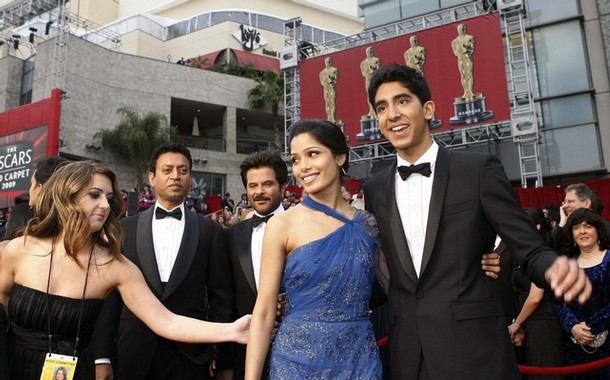
Beyond the marketing itself, it seems much of the visual coverage surrounding Slumdog has also been overly “correct.” That’s why I like the top image, which calls out the thorough staginess of the Oscars by capturing an intentionally well-dressed photo assistant positioning Freida Pinto’s arm for a publicity picture.

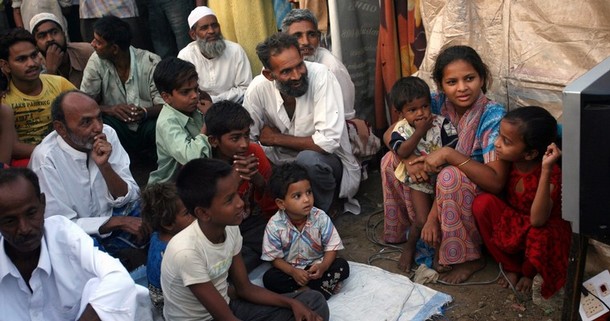
What stands out in the second photo — especially as compared with related images (1, 2) — is how much the Mumbai slum residents, under the observation of photographers and journalists, become “feel good” actors again in this engaging moment watching the Academy Awards on T.V.

(image 1:Mario Anzuoni/Reuters. caption: Actors Irrfan Khan (2nd L), Anil Kapoor (C), Freida Pinto (2nd R) and Dev Patel (R) of “Slumdog Millionaire” arrive at the 81st Academy Awards in Hollywood, California February 22, 2009. image 2:Arko Datta/Reuters. caption: Neighbours of Azharuddin Ismail, who acted in ‘Slumdog Millionaire,’ gather to watch the 81st Academy Awards presentation on television outside their homes in Mumbai February 23, 2009. Ismail, along with the other cast members of the film, are in Los Angeles for the Oscars ceremony.)

  • http://profile.typepad.com/6p010536b2fa33970c Lightkeeper

    The problem with the film is not so much that it is made by mostly white Brits (who inevitably bring their occidental gaze to bear upon the slums), but rather that it is a representation – and like all representations, should be open for debate, and should at the very least, be acknowledged as representation. Representations are always inauthentic in some shape or form – and I feel this is really lacking in the discourse surrounding Slumdog. To me this film is more like a poverty tourism brochure passing as a best picture nominee rather than an authentic portrayal of the brutality of poverty in the “third world.” The top picture really captures that, but like the bag says, even authentic slum dwellers become actors (or take the place of actors) when the camera looks at them.
    Great post Bag.

  • jtfromBC

    Bag your first pic and remark just about says it all and compliments Arundhati Roy’s take
    “People are selling India’s poverty big time both in literature and films. As they say, there is lots of money in poverty today. I am not against showing slums, but depicting them in a depoliticised manner, as has been done in the film, is quite unfortunate. Films do not show the real poor. Even if they are depicted, it’s not the true picture. The real poor are not shown in films because they are not attractive. Poverty sells but the poor do not. The film gives false hope to the poor that they too could become millionaires one day. Watching Slumdog Millionaire was like speeding on a highway with lots of potholes. The screenplay of the film is quite out of context and it feels as if a Harvard accent has been given to characters that are straight out of the Chicago black neighbourhood.”
    http://timesofindia.indiatimes.com/articleshow/4112989.cms

  • bacalove

    If you can, please post a picture of Michelle Obama’s dress Sunday night at the governor’s black-tie dinner, in which she looked fabulous and like a million dollars. I really loved that dress.

  • d

    I loved the film as a fictional film. It’s not a documentary, and it shouldn’t be gauged by the standards of a documentary, i.e. by how accurately it reflects the reality of life in the slums.
    But what is so galling and even appalling—which Bag hits right on the head—is that the marketing of the film (by Fox and the Media-media) tries to turn what is essentially fictionalized escapism into some sort of heroic “moment” of understanding for the audience: “come see the feel-good film that will educate you about Indian poverty, and yet still entertain you! and it will all turn out fine in the end, so you won’t have to do anything at all but watch!” Glib marketing magically transforms entertaining spectatorship into edification, which then is supposed to stand in for moral action. i.e. we don’t need to worry about poverty, ’cause the good will always win in the end.
    A similar scene happened with Schindler’s List so many years ago. A great film (with amazing acting), but it is not (NOT!) a history of the Holocaust in any way, shape or form. Yet the glitterati, lucre-ati, and vaporati sought to treat it as such. Which only infuriated those who know quite a bit about the actual Holocaust. And if treated as history (rather than as entertaining escapism) the film’s happy ending carries the unpleasant, inescapable connotation that others who were not so lucky as Schindler’s Saved were perhaps also not as worthy…
    But fictional film is not history. It’s supposed to be entertaining escapism, with maybe a bit of insight into the human condition thrown in for good measure. One of the things I loved about “Slumdog Millionaire” as fiction is its non-Hollywood, non-American insight: Sure, the guy gets to be a millionaire in the end, but he genuinely couldn’t care less—his desires are more ethereal. Meanwhile, all those around him (with their real, everyday needs) are utterly crushed by the harshness of the world they live in. I just can’t imagine a film like this being made in mainstream Hollywood. It’s so un-American, because it’s so clear that the main character is not some sort of bootstrap-puller or self-made hero: he only meanders along a pre-written destiny—the only larger significance of which is that it gives (false?) hope to millions of hopeless people without a future.
    I came out of the film smiling, but despite the film’s joy, I think it has a profoundly hard-hitting sensibility. (in a way reminiscent of Trainspotting)

  • NYCartist

    I heard the people in the neighborhood, in the photo, were looking at a black and white tv, which doesn’t show in the photo.

  • http://www.errolmorris.com/content/interview/stopsmiling0306.html yg

    i haven’t seen this movie yet, but i’ve seen some bollywood films. they don’t concentrate on poverty. do you blame them? movies is where they escape such realities. i like how they create dancing scenes out of people riding on top of a moving train’s roof. (yikes)
    remember the dress made out of stitched together american express gold card? that kind of vulgarity wouldn’t be tolerated today.

  • http://www.youtube.com/watch?v=AOOlgbfFy3k&feature=related yg

    listen to this song:
    http://www.youtube.com/watch?v=AOOlgbfFy3k&feature=related
    there is something timeless about it.