BagNews Archives About Staff BagNews is a progressive site dedicated to visual politics and the analysis of news images.
Sunday, February 12, 2012

Twitter

@bagnewsnotes »
Advertisement


January 2, 2009

Getting Killed Out There

Afghanistan prop wash.JPG

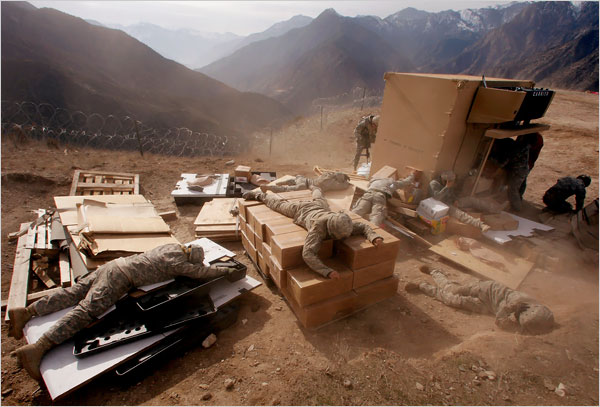
I find this an extraordinarily effective, if emotionally heavy-handed visual status update on U.S. military activity in Afghanistan. It’s found (without any story link or other context) in today’s NYT Pictures of the Day slideshow.

Looking at the image, you could say the message is “we’re getting killed out there.” … You could only say that, however, after reading the caption (after the jump).

(image: Bob Strong/Reuters)

“American soldiers held on to boxes and shielded themselves from the prop wash as a helicopter landed at Observation Post Mace in eastern Afghanistan’s remote Nuristan Province.”

  • jtfromBC

    Who Are the Taliban? Dec 4th, 2008 by Anand Gopal
    “If there is an exact location marking the West’s failures in Afghanistan, it is …”.
    ~this article is a must read for understanding the basic challenges in delivering democracy or freedom or schools or whatever it is we are trying to do there.
    These lads on Observation Post Mace are certainly in for an adventure.
    “Despite such foreign connections, the Afghan rebellion remains mostly a homegrown affair. Foreign fighters — especially al-Qaeda — have little ideological influence on most of the insurgency, and most Afghans keep their distance from such outsiders.
    “Sometimes groups of foreigners speaking different languages walk past,” Ghazni resident Fazel Wali recalls. “We never talk to them and they don’t talk to us.”
    Al-Qaeda’s vision of global jihad doesn’t resonate in the rugged highlands and windswept deserts of southern Afghanistan. Instead, the major concern throughout much of the country is intensely local: personal safety.
    In a world of endless war, with a predatory government, roving bandits, and Hellfire missiles, support goes to those who can bring security…”
    http://anandgopal.com/who-are-the-taliban/#more-129

  • Trev

    If they spent more time hunting the bad guys instead of lounging around they might have been home years ago

  • http://profile.typekey.com/dquaranta@earthlink.net/ DennisQ

    The bad guys are the people who live there. The good guys are soldiers from thousands of miles away. Frankly, I have difficulty with this assessment of the situation. How old is Afghanistan anyhow? What are we doing there?

  • thomas

    In war reportage from Afghanistan one of the most consistent reminders we get concerns the impossibly difficult, inhospitable, impenetrably mountainous terrain of northeastern Afghanistan. How it frustrated the British and the Russians and now the Americans, how it refuses all attempts at governance by Pakistan and India. The hidden fortress of radical tribalism. Any casual hiker or mountain climber will look at this photo and see exactly that, without further explanation.
    To think of George W. Bush recreating on his mountain bike, or Condoleeza Rice, devotee of symbols, sitting at a piano deploying classical icons, and all the neocons in this administration who chose not to reconcile their physicality in the military, and did not bivouac for an attempt on a Rocky Mountain peak, or a summit of the Cascade Range, for whom the Grand Tetons are a picturesque backdrop for the annual Christmas card. Richard Cheney, whose encounters with the exigencies of wilderness have taught him to only hunt birds that have already been captured, has dispatched the advance guard into lands he doesn’t understand.
    Whether they are being killed out there in the mountains of Afghanistan, or holding down the fort, or resting from their efforts, or waiting for a new opportunity, American soldiers are, in truth, also serving masters who are headed back to the golf course, back to the refreshments in the conference room, back to considerations of their legacy, their legal exposure, their libraries. It seems that, for the moment, our men and women in uniform are a bit stranded out there.

  • cenoxo

    Dead GIs on Buna Beach — George Strock, Papua New Guinea, 1943.
    Federal Soldiers, Gettysburg, Pennsylvania — Timothy H. O’Sullivan, July 1863. This image was used with the following text for Plate 37 in Alexander Gardner’s Photographic Sketch Book of the War (1865-66):
    The dead shown in the photograph were our own men. The picture represents only a single spot on the long line of killed, which after the fight extended across the fields. Some of the dead presented an aspect which showed that they had suffered severely just previous to dissolution, but these were few in number compared with those who wore a calm and resigned expression, as though they had passed away in the act of prayer. Others had a smile on their faces, and looked as if they were in the act of speaking. Some lay stretched on their backs, as if friendly hands had prepared them for burial. Some were still resting on one knee, their hands grasping their muskets. In some instances the cartridge remained between the teeth, or the musket was held in one hand, and the other was uplifted as though to ward a blow, or appealing to heaven. The faces of all were pale, as though cut in marble, and as the wind swept across the battle-field it waved the hair, and gave the bodies such an appearance of life that a spectator could hardly help thinking they were about to rise to continue the fight.
    For the dead, however, the fight was over: only the living remained to be added to their ranks.
    War photographers need a lot less work.

  • http://theforgottenwar.blogspot.com Sergei Andropov

    Ah, Nuristan.
    If the border region in general is like another country, then Nuristan is like another world, located in another solar system. It is so isolated, so impenetrable, that it was not until just over a century ago that Islam reached it. Its inhabitants speak their own languages, which are neither Iranian, like Persian (Dari) and Pashto, nor Indic, like Urdu and the Dardic languages of northern Pakistan, but are rather descended from the third Aryan people, mentioned in the Avesta, of whom no trace remains elsewhere.
    In all their 3,000 year long history, only two people have managed to conquer Nuristan: Alexander the Great and Abdu’r-Raḥmán Khán, the Iron Emir of Afghanistan. Everyone else has known better than to even try. We certainly have no hope of it; unlike Al and Abd, we are not murderous psychopaths willing to throw everything we’ve got at them simply to show that we can. I expect Nuristan to be the great puzzle of the Obama administration. Wardak and Logar can be solved through simple force, the country as a whole through a combination of force, national reconstruction, and political and governmental reform, but Nuristan defies all these things. The only solution there is a peace deal, but Nuristan is one of the most religiously conservative parts of the entire country; they take Jihad seriously up there. What’s more, Obama will almost certainly face withering political attacks here at home for “negotiating with terrorists”, and “surrendering part of Afghanistan to the Taliban”.
    Nuristan, ah, Nuristan. Whatever are we going to do with you?

  • http://www.bizimlesohbet.com sohbet

    The bad guys are the people who live there

  • cenoxo

    Nuristan — Steve McCurry, 1980.
    A Historical Timeline of Afghanistan, 1979-1986 — PBS Online News Hour.
    We’ll meet the enemy, and he is us.

  • http://www.bizimlesohbet.com sohbet

    In a world of endless war, with a predatory government, roving bandits, and Hellfire missiles, support goes to those who can bring security