BagNews Archives About Staff BagNews is a progressive site dedicated to visual politics and the analysis of news images.
Wednesday, May 23, 2012
January 25, 2008

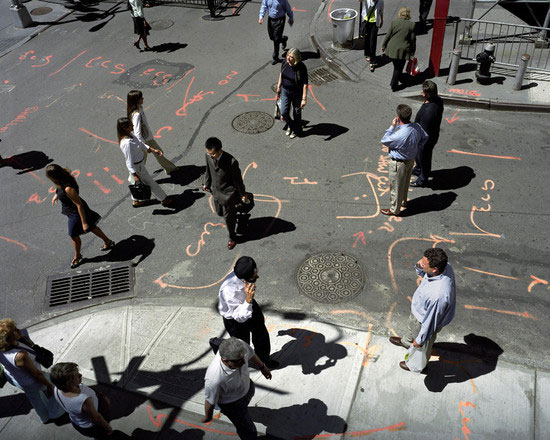
Painted Construction Markings

7642937-550Px

Last week, I had the pleasure of hanging out a bit with photographers Spencer Platt, David Butow, and BNN contributer Nina Berman.  As winners in last year’s World Press Photo competition, the three were participating in a two-day program at USC’s Annenberg School in conjunction with the WP exhibition.

Spencer was the “Photo of the Year” winner, and Nina earned first place in the portrait category for her “Marine Wedding” image — which I posted after the announcement, and which we discussed extensively here at The BAG.  It’s David’s shot, however — the second place winner in the “Daily Life” category, behind Spencer’s — that I’ve spent a good bit of time looking at, and am pleased to finally share with you.

My meeting David though, besides being a pleasure, also offered a healthy reminder about the subjectivity of social and political imagery.

To set the table, you have to understand that most people who see this photo — including the World Press judges — are also provided the following description:

Pedestrians cross a section of Wall Street covered in painted construction markings, near the New York Stock Exchange, shortly before the fifth anniversary of the 9/11 attack on the city’s World Trade Center. The former WTC site and parts of lower Manhattan were still in the rebuilding process following the attack.

Because my knowledge of the picture has been so interwoven with the description, I wouldn’t know how to separate the two.  That being said — and I’ve seen the same interpretation made by a few other visually and politically oriented people I know — whenever I look at this photo, those construction markings remind me of Arabic.

Now, I don’t know if I saw it that way on first look, or it was prompted by the description.  Either way, I now tend to take those street markings; combine them with the guy in the foreground in the turban (although likely Sikh, not Muslim);  add in the Semitic-looking guy pulling the bag while crossing the street; combine that with the known proximity to the WTC site and the anniversary, and I get a powerful sense of those attacks having left a psychic fingerprint on the city, creating an emotional floor under the otherwise everyday comings and goings.

So, what was really illuminating was the opportunity to share this association with David Butow.  After giving him the quick sketch, however, despite the smile and his obvious interest, he related that nobody had ever offered this take about Arabic writing before.

Your Turn: Rites Of Passage (Nina Berman’s Marine Wedding (BAGnewsNotes)

2007 World Press Photo of the Year – Spencer Platt/Southern Lebanon (World Press)

Photojournalists honored at Annenberg reception (Daily Trojan)

World Press Photo exhibit opens at USC Annenberg

DavidButow.com

(image: © David Butow/Redux.  New York, August 1, 2006)

  • jkb_55N

    No, I saw it as Arabic or similar before I read the caption. But the ‘Arabic’ was mixed up with
    ‘Shorthand?’
    ‘Did The BAG add the lines and if so, why?’
    ‘Is it street theatre?’
    ‘Is it a protest, in the same way as chalk outlines appear on Hiroshima day?’
    It certainly looks as if all those people are being directed and just as strongly that they are ignoring the instructions. A good metaphor for the disdain that is natural business behaviour?

  • shem

    Ditto for me, seeing first just the photo via google-reader; primed by Baghdad being often an initial assumption for ‘The BAG,’ the preceding leader in google-reader, “… this picture near Baquba …” and the combination of its header and this one: “A War Of Perception / Painted Construction Markers”

  • http://www.jaxxattaxx.com/ black dog barking

    Streets scenes in movies often have a hard-to-articulate but noticeable air of unreality about them — something’s just not right. The background characters are often moving hurriedly in random directions, none of them looking at the camera or the action that draws our attention. Cowboy western street scenes are the worst because they are typically set in areas of low population density. You quickly calculate that every living person in the town’s trade area has to be in that street at that moment, too busy walking to have any time to chat.
    This street scene, in contrast, plays as real. People are looking every which way, ambling and hurrying, or stopped and chatting. Attire is business casual, it’s a nice day with strong sun shadows. The construction related scrawls on the street mean nothing to me other than they appear to have purpose — they’re not graffiti. It is no stretch to imagine the writing is some kind of mathematic white-boarding, a description perhaps of the purpose behind the purpose behind whatever motivates the individuals walking above — the image captures a theory or theories mapped behind life as practiced by all of us. Of course we the people pay no attention to the math.
    It this is Wall Street then we’re looking down at a Random Walk.

  • http://www.bagnewsnotes.com The BAG

    Noooo, BAG did not add a squiggle.

  • Jacques

    If it’s any consolation I thought it was going to be a photo about life in Iraq or something, and I was caught off guard by the normalcy of the scene, especially the plethora of pedestrians phoning phil.

  • Cactus

    Exquisite ambiguity. When I first saw this I thought the markings were where the debris lay after a car bombing in Iraq. The people all have dark hair and three men are staring off camera view at something on the left and others seem to be walking away from the left. Even the two women in center with long black hair that could have been scarves. A further hint at chaos is that people seem to be walking in all different directions. Then you notice that no one seems to be in a hurry and there is actually a rather nonchalant feel to the photo.

  • http://reciprocity-failure.blogspot.com Stan B.

    Sometimes a cigar is just a cigar…

  • Mad_nVT

    The manhole covers seem to have a middle eastern pattern also, like in the carved screens in the mosques.
    But the three women with sleeveless blouses are a sure indication that conservative middle eastern culture hasn’t take over lower Manhattan.

  • itwasntme

    I thought this might be a picture of down-town Beirut.