BagNews Archives About Staff BagNews is a progressive site dedicated to visual politics and the analysis of news images.
Monday, February 13, 2012
March 11, 2007

Your Turn: 120 Days

Claxtonopton

I have an admission to make.

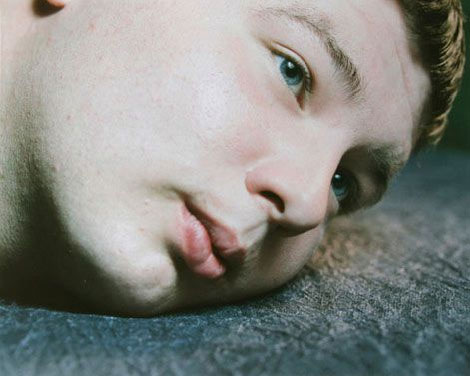
Between Suzanne Opton’s most recent portraits of soliders from Fort Drum, and her previous series, I decided to show you the previous images.  I found the newer work almost too odd to look at.  When I put examples of each side-by-side, however, it was clear that the newer photos called for attention.

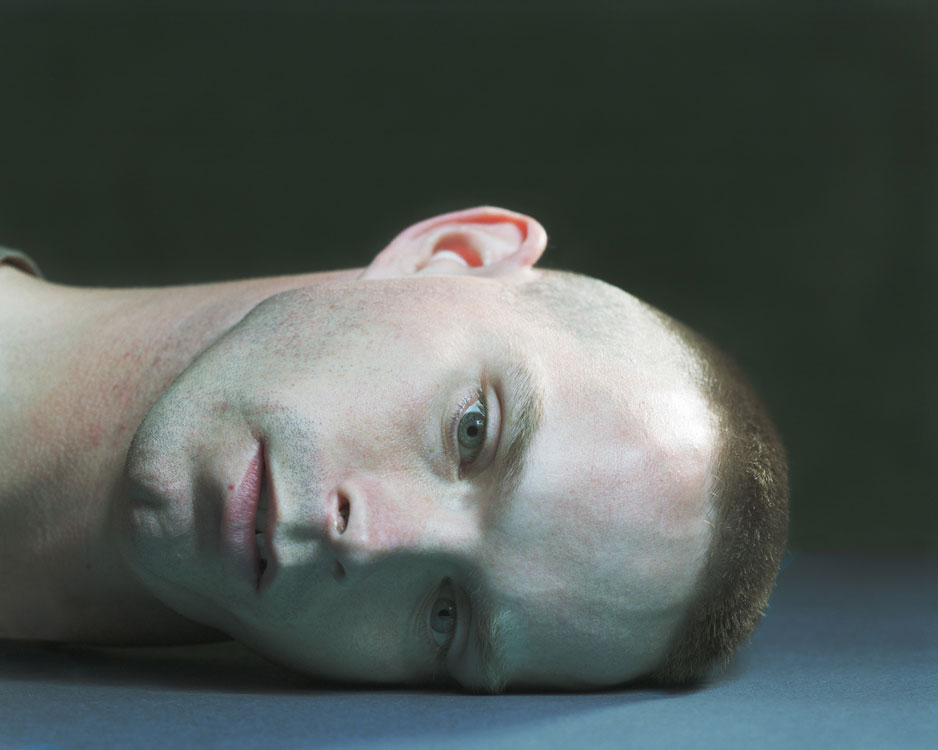
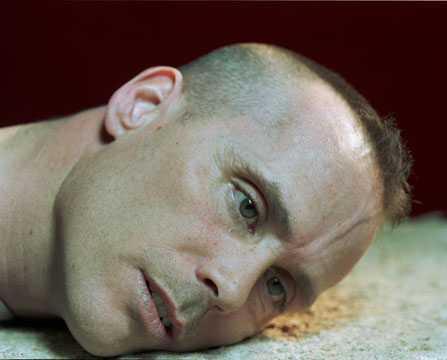
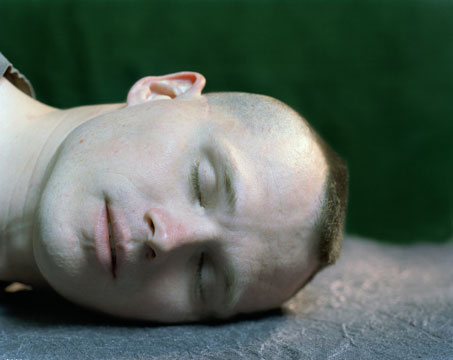
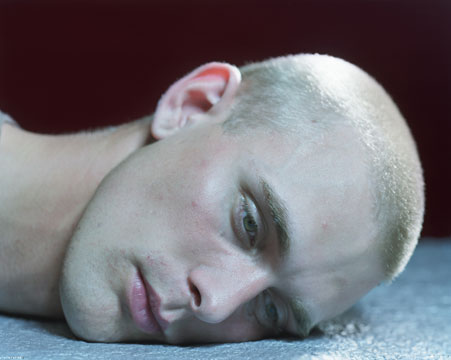
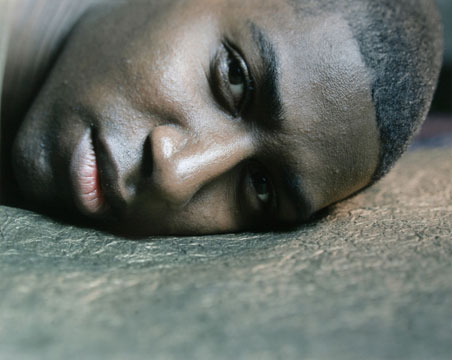
Given the amount of time we have spent looking at war-related images, and the practiced eye of The BAG readership, I hesitate to say much about Claxton (above) or (below – l to r, top to bottom) Jefferson, Dougherty, Pry, Morris, Kimball or Birkholz.  (Though I urge you — if you can handle the emotional and bandwidth demand — to click open and study Claxton.  All the images open at a larger size, but Claxton reveals himself at the full 938 x 750.)
Jefferson2Opton Doughertyopton

Pryopton Morris

Opton-Kimball-1  Birkholzopton

According to Opton, the work is about vulnerability.  All the portraits were taken in 2004-5 at Fort Drum, New York, after the soldiers had returned from either Iraq or Afghanistan and were awaiting redeployment.  The soldiers were aware of the subject and were given the chance to “retreat from self-consciousness into the interior of their minds.”

Beyond that, we have the following:

Claxton: 120 Days in Afghanistan

Jefferson: length of service unknown

Dougherty: 302 Days in Afghanistan

Pry: 210 Days in Afghanistan

Morris: 100 Days in Iraq

Kimball: 287 Days in Afghanistan

Birkholz: 353 Days in Iraq, 205 Days in Afghanistan

My one thought, before I make room for discussion, is to wonder: is just the experience of approaching these images its own metaphor for the war?  My first inclination — probably a common one — was to keep my distance.  Continuing to look, I didn’t know where I went or for how long.

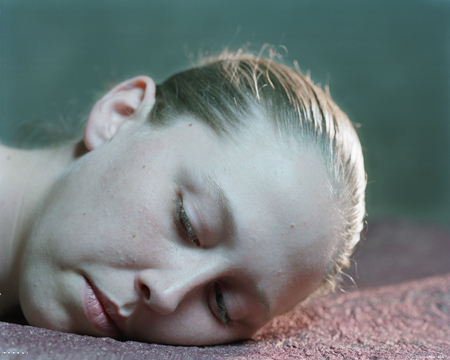
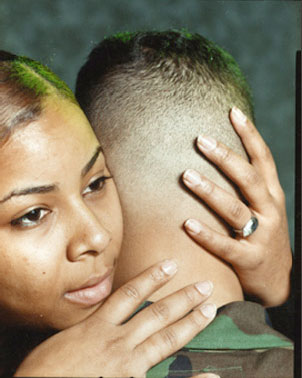
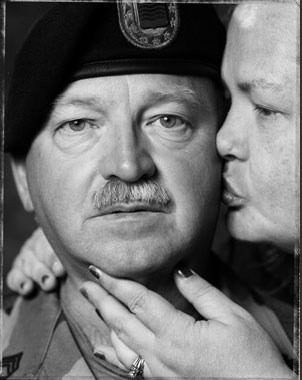
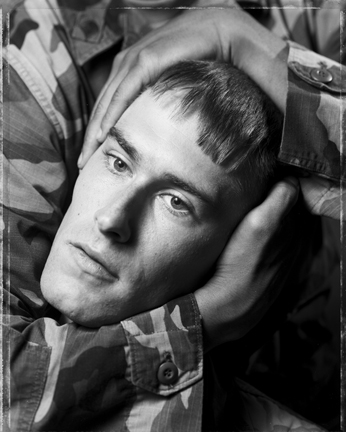
For your further consideration, I also offer three shots from the previous series (Chapter III).  Suzanne will be available until Wednesday to answer questions or respond to points in the comment thread.  Otherwise, you can view additional images at her website.  The gallery links will also lead you to more statements and information.
Auvenshine Opton-Jimenez-1 Opton-Benson-1

Suzanne Opton’s website .

Exhibitions:

February 15th – Mar 24: Peter Hay Halpert Fine Art/NYC (link);

March 07: Blue Sky Gallery/Portland, Oregon. (link). www.blueskygallery.org

All images ©Suzanne Opton.  New York 2005.  Posted by permission.

  • http://www.theunapologeticmexican.org Nezua Limón Xolagrafik-Jonez

    i want to see one on the iraqi children, personally. i’m tired of all the loveydovey for our great and glorious killing machine.
    and…are these choices representative of the racial makeup of our armed services? interesting. i always thought more brown people were sucked up into our war grinder. not that she is beholden to accurately represent the racial makeup or anything. everyone is allowed favorites! and looking closer, it seems her work, all categories, has about the same ratio. one brown face to five or six pink ones. not a crime. just something i notice.

  • http://www.theunapologeticmexican.org Nezua Limón Xolagrafik-Jonez

    i may be missing something, but i don’t even know what this series is saying. it feels very contrived but to what end? what exactly is this series representative of? why are they positioned so? the artist’s site says they are simply recently returned to the war. why are they lying on the carpet, clothed, with their head askance?
    and My one thought, before I make room for discussion, is to wonder: if just the experience of approaching these images its own metaphor for the war?
    um…no? it’s a picture game that websurfers are engaging in. it is nothing like a nation-state’s mass-murder for control of oil. this little sentence trivializes what america is doing over there and has been for years.

  • tina

    Well, to me these are a little heavy handed; they hint rather obviously that the soldiers are already dead (lying there with eyes closed) or numbed, striving much too hard for an otherworldly look….compare with the photos of the badly wounded vet getting married, a series which evoked a more complex set of emotions and carried a lot more impact.
    Yes, I’m sure these soldiers have seen a lot; this life knowledge is, I guess, supposed to be reflected in their eyes. But I can’t escape the impression that this is remarkable only because we live in a society where people are so understimulated that a person who has actually had a few experiences–traumatic or otherwise–is such a rarity that people are jolted and don’t know how to respond.
    If we could look into the eyes of Iraqis and Afghanis, men, women and children, would we be similarly moved? I guess not, ’cause nobody’s going around making artsy gallery quality blowups of THEIR bombed out facial expressions.
    I just don’t think the pictures say much….dead, bombed out, etc. etc., and like the dead, some of the subjects almost look peaceful and resigned to their fate….
    I take that back. Orwell wrote that it’s a misconception that the dead look peaceful, he said “most of the corpses I have seen look devilish”. I bet that’s especially true of the corpses produced by the uber-violence of Iraq.
    Here’s a thought: pair these angelic glossies with some good close ups of the faces of any dozen or so of the executed torture victims that turn up every morning dumped on the streets of Baghdad. Put them side by side and in similar proportion.
    Now THAT would be interesting viewing.

  • tina

    Here’s another thought…I immediately thought of Prozac and other artificial aids for a peaceful expression, esp. for the young Claxton, who does a better job of the others with the whole emptied-out look…sorry to say he reminds me of a model, though, esp. the vacant-eyed ones employed by the Benneton campaign.
    I’m with Nezua, we’re being sold something…but what?

  • Patrick

    It was my initial impression also and I agree with Tina that the photo’s are posed as if the soldiers are lying dead. The eerie eyes wide open shots are reminiscent of those of someone being struck down in complete surprise from say, a snipers bullet, dying with eyes transfixed. The military brass has worked OT to meet Bush stringent requirement to sanitize/eliminate all photos/video of US troop deaths for mass media consumption. The Dover transfer tube arrivals and the nightly news cleaned of unpleasantness for example. Unfortunately, the www is full of live action US troop deaths from sniper video to exploding IED Humvee attacks. The Arab world is just as wired/program literate as any in the west. Wait until Iran comes under attack then subsequently, on line, with the second largest blogging population per capita on the planet. The photo blogs should be exquisite.
    I respectfully disagree with Nezua Limón Xolagrafik-Jonez on a few points. Unfortunately, I have viewed all too many photos of dead Iraqi’s including, children. The internet is full of examples and the MSM is more free in publishing these prints in newspapers and magazines. Television is still void of these scenes in most all instances. I agree that the love affair with those in uniform seems overdone but, someone has to love these kids as Bush and the right certainly do not. I am more pissed off at the Ameri-Nazi’s who question my patriotism/ call me traitor when the mistreatment of our troops is brought to light. 3,190 dead, 27,326 wounded, 10’s of thousands more with PTSD, three and now four rotations, lack of any clear orders/objectives, poor supplies/equipment, lack of proper armor, the Walter Reed scandal and now a report that 60,000 military divorces since the wars inception (yes, that is correct a 6 followed by 4 zeros). The confusion of war that forces the deaths of innocent Iraqi’s inflicted by my countrymen is on me just as much as on them. I, as an American, am a war criminal.
    The misconception that people of color make up the bulk of our fighting forces is probably common but, it is incorrect. The racial breakdown of the US Army in 2005 is as follows with (%) of US population as a whole as comparative;
    American Indian/Alaska Native= 2.01% (0.75%)
    Asian= 2.82% (4.23%)
    Black/African American= 14.54% (14.25%)
    Hawaii Native/Pacific Islander= 1.05% (0.14%)
    White= 73.12% (75.62%)
    What was troubling is that DOD statistics did not provide a classification Hispanic personnel who are bravely fighting in the service of their country.
    Finally, a fully agree that what we are committing is nothing short of mass murder and as an American who truly believes in accountability I’ll reconfirm my previous statement in my admitted guilt as a war criminal.

  • http://www.reciprocity-failure.com Stan B

    At risk of exposing my own limited artistic sensibilities, I find this “newer” work just plain… silly. Minimalism at its creative worst, attempting to deliver waves of emotion and meaning, and falling, ummm… flat on its face.
    The first portrait in the Chapter lll series with its disturbingly dislocated head is phenomenal, the color shot quite poignant, and the one to the right, though more conventional, intense for the look of its subject’s gaze alone.
    Then again, these are the opinions of a photographer w/o gallery representation.

  • tina

    It’s as Dorothy Parker wrote, “It is too bad that the light in a person’s eyes is only the light in a person’s eyes, and you cannot tell at a look what causes it. You do not know if it is…about you, or about something else”.
    The root problem is we can’t know what these guys are thinking, we can only impose our ideas based on knowing that they are SOLDIERS(which is beaten into our heads at every juncture, and even on billboards according to the site), which conjures up (for us) horrors that they may or may not have seen.
    If we didn’t know that they were soldiers, the pictures would have no meaning, none, zero, zip. We might imterpret them as depressed drug addicts, or prospective grad students bummed that they didn’t get accepted into Harvard Law. We just don’t know, do we?
    Nothing, except they look sort of detached and reflective. I must admit there is some real weltshmerz about Mr. Birkholz, though.
    Now due to the camo we do know that the Chapter III series is about soldiers, and that gives us something more, although I wouldn’t argue they are the most insightful soldier portraits ever. The presence of the arms, hands, and faces of the other people is a useful, though not exactly groundbreaking, innovation.
    I was always deeply moved by group photos of soldiers of different nationalities and eras who would pose with some little dog or cat they adopted while at the front. Once I even saw a group posing with a white rabbit which they kept on the front lines. There was something about the desire of the soldiers to nurture and care for a pet in the midst of all the killing that was heartbreaking. These photos are numerous as this was a common practice.
    I guess I can’t get enough cues from Opton’s staring eyes alone to make those connections. Just not enough there.

  • ummabdulla

    Patrick: “…White= 73.12% (75.62%)
    “What was troubling is that DOD statistics did not provide a classification Hispanic personnel who are bravely fighting in the service of their country…”
    It makes it hard to know how many of these “whites” are Hispanic. American citizens as well as those from other countries who are rewarded with green cards.
    As for the photos, I don’t really know what to say. It might help to know what the circumstances were, what instructions they were given by the photographer…

  • ummabdulla

    One other thing to be factored in for the women soldiers is sexual harassment (at least) by their fellow soldiers:
    The private war of women soldiers

  • jtfromBC

    ummabdulla, go to Opton’s home page where there’ a link to an eight minute interview on NPR regarding these photographs.

  • Patrick

    ummabdulla,
    Hello. How are you? Yes, you are correct in that it is difficult to ascertain who is ‘white’ and who is ‘hispanic’ within the US armed forces. That the US military has resorted to recruiting mercenaries from developing countries with the promise of green card/citizenship in exchange for active duty military service to meet lagging manpower quotas has troubled me from the time this was first reported by the MSM. The US stepped over the line to empire/colonial power by recruiting from within the periphery of the realm. Just how important is this war to Americans if they are not willing to provide sons to fight it? This war seems if pre-planned as not to burden the average American with any hardship whatsoever and has become a central talking point for the right in support of conquest that our military is ‘all volunteer’. If I recall, it was Bush’s clarion call encouraging us all ‘to go shopping’ shortly after 9/11. In all of this mess it is the liberals who I am most disappointed with. While at a gas station a few months ago a middle aged man with teens openly/loudly complained about the price of gasoline while fueling his $40k Chevy Suburban. I felt like telling him to head on over to the local Marine recruiting station to drop off the kids but, instead held my tongue. It is another lesson of the Vietnam War that the Pentagon learned well. Avoid a draft at all costs and do not antagonize the mothers of America who played such a vital role in ending our involvement in Southeast Asia. Can you imagine the soccer/helicopter moms reaction if Junior/Muffy were subject to mandatory selective service?
    Back to the photo’s… the more I look at them the more they remind me of mannequins.

  • maureenh

    What struck me is that only the second soldier down looks the viewer in the eye… Was that part of the instructions? And if not, what does that say, that those back from a war cannot look directly into a camera (or maybe a mirror?)?
    Covering the soldiers returning is a tricky thing- god forbid anyone step outside the “love the troops cause they’re brave/or cause we hate the people who put them in danger” rhetoric, but I wish that we had more complete stories about what the soldiers are like as complete humans and what we can learn from how they’re changed.

  • lytom

    I find the faces like death masks.
    Empty, used up, cleaned up yet underlined with exhaustion and “shocked out of their normal self.”
    Uncommunitive, holding secrets, “locked up as heroes” in the MSM and now here…
    Beheaded from their body…and soul just not there.
    All having left side of the face hidden…
    Cold and alien!

  • http://www.suzanneopton.com Suzanne Opton

    These photographs were not meant as a political statement, but rather as a way of looking at the effects of war experience on individual soldiers. This is not photojournalism but rather a conceptual look at a real situation in time. The intention is to look at people lost in thought. The images were made with a large format camera, and the subjects had to hold a rather awkward position for an uncomfortable period of time, during which their minds might wander. The only direction was to look at the camera or look away.
    I plan to make a related series of images of another group of “victims of war” – Iraqis who have fled to Jordan since the American invasion. If anyone who is interested in such work would like to help support the project, I would be happy to discuss. Thank you for your thoughtful comments.

  • http://www.aol.com NoContest

    I know that look, that feeling, I have the same condition of burned out emotion, like an emotional lobotomy. Since my situation occured over four years ago I have had an attempted armed robbery, several potential fights, and other hostile, potentially volitile situations…. and I never broke a sweat or batted an eye.
    The aggressor looked into my face and saw that he was dealing with a person who has ice water in his veins. I sometimes carry a handgun. I always carry a knife. If the situation would have escalated they would have had a hole in their juggular, and I would not have worried about the consequences. That is the same way I am right now.
    I just deal with what I have to deal with and take the fallout as it comes.
    That is what I can tell you about those soldiers.
    It is more of a rarity in America,… unless you frequent getto areas, like I do, and you know poverty and desperation. By the way…… That look it NOT a rareity in many other parts of the world, in Africa, in Palestine, in Iraq, in India.
    That is the look of a man who has gone toe to toe with the devil…. and the devil has gone away in search of easier prey.

  • ummabdulla

    Thanks, JT.
    Patrick, I know they want to avoid the draft at all costs, but then they’re stretching the military to its limits. At some point, something’s gotta give.

  • japandrew

    For me these photos are just what they are, the physical reality of a human face. That is the aspect and reality that has been snuffed out of portayals of this conflict. These photos bring that back for me in a way I find very moving. Humanity is not a zero-sum game. Showing the humanity of U.S. soldiers does not detract or negate the humanity of Iraqi children. They are all utterly human. Thank you for this powerful work.

  • http://www.wednesdaywire.com Hubris Sonic

    wow, very powerful. as a veteran, i cant help but think these soldiers will have trouble sleeping some 20 odd years from now. as i do.

  • Patrick

    ummabdulla,
    Agreed. Bush can continue to avoid the draft but, for how long is the question. With the support of an astoundingly weak Democratic controlled Congress and a once again asleep at the wheel electorate very few, if any other than those of us alert at the Bag, have looked the other way as Bush has ordered and additional under the radar 4,700 troops to Iraq over/above the 21,500 pre-approved under the ‘Surge’ initiative and 3,500 troops to Afghanistan previously not requested. Bush ability to call up troops, at will, unchallenged/unquestioned has made a draft mute although Andy Rooney made a boisterous call for such last night on ‘60 Minutes’.

  • John Hoffman

    These soldiers have already checked out of this life. If they do not receive PTSD treatment soon, when they are cut loose from the military they will all be making headlines as they kill themselves or spouses or hapless strangers. Look at the eyes. These guys are gone.
    End the war now, because the tab for society just keeps getting exponentially bigger as we waste time with non-binding resolutions.

  • tina

    Ms. Opton,
    These pictures become a political statement based on the continual front and center insistence that the men ARE SOLDIERS–and let’s not forget it! As the New Yorker reviewer points out, this invites the viewer’s imagination to run wild visualizing their trauma, which I find a little bit dishonest somewhow. I think we need to know something about their real situation, not what we might create in our minds for them–imposing our reactions based on nothing, a total lack of visual or other informataion, is the same thing as putting words in someone else’s mouth in my view. How do we know they are all permanent emotional cripples, based on their expressions while lying with their faces sidewise, as you said, uncomfortably? But that’s the conclusion of everybody on the thread. An obvious conclusion but kind of cheap.
    I’m speculating that because the series is about the soldiers and Iraq, this increases its chances of gallery representation. In other words, the work is getting attention because it is politically relevant and timely. So let’s not then go and say there is nothing political about it the moment it is criticized.
    I think similar pictures could be taken of many different groups of stressed out humans, but they will not all get reviewed by the New Yorker. This leaves a bad taste in my mouth. It smacks of sensationalism somehow.
    Maybe these blank expressions are extremely profound in some way (although I don’t find them to be so), but that does not by extension make the pictures insightful. There has to be something for the viewer to “read” that’s NOT coming from inside his/her own head.

  • margaret

    What I noticed about the photographs is how beautiful these soldiers are. They have witnessed the horrors of war, participating in the violence out of a sense of duty, and yet, they are still beautiful human beings. [With souls and memories.]
    The other thing I noticed was the venom of the comments which underscores my perception of what has happened to people in our media-image driven culture over the past 40 or so years. I am in my late 60’s and my generation can still “read” a face, empathizing with what we find there. TV, especially, and now, the computer, has affected how people perceive each other. I find people are becoming one-dimensional, superficial, and their treatment and opinions of one another, reflective of an inability to recognize nuances in human countenance. It is the perfect accompaniment to the requirements of a police state: de-humanization. Except: we are still human animals.

  • PTate in FR

    We have discussed portraiture before on BAGnewNotes, and how the subject. I think this particular series is too twee for my tastes. As Richard Aveden, God of portraiture, said, “Sometimes I think all my pictures are just pictures of me. My concern is… the human predicament; only what I consider the human predicament may simply be my own. “
    To obtain these photos, the photographer recruited soldiers, newly returned from American wars, had them lie down, reassured herself that because she had informed them of her purpose it was okay, and asked them to “retreat from self-consciousness into the interior of their minds.” *snap* Now I am supposed to draw meaning about their inner lives from these?
    The photos were taken while the soldiers lie as if DEAD. Death is a fair theme. Vulnerability is a fair theme. Since Bushco has done its best to hide images of the American dead, it seems fair for artists to remind us. (Other pictures also remind us: we’ve discussed the response of the pregnant young widow, the maimed young man at his wedding, the family of the young man who was given the medal of honor.) This set of portraits seems to fall in an artistic category that I would call “the power of lots of real dead people”–other examples would be the Vietnam war memorial monument or the set of images of those who died in 9/11 recorded by the NYTimes. Andy Warhol’s Marilyn Monroe portraits might be another variation.
    But I have a number of objections to the way in which these particular portraits have been manipulated. First, humans are much better at perceiving and reading faces in the normal upright orientation. Second, the very act of lying distorts the face. Third, emotions are expressed more intensely on the left side of the face, but here, the left side of the face is the one that is smooched against the ground. Finally, the soldiers have their heads shaved in the geeky army way which automatically strips people of their individual dignity. So I question how we can read anything into these faces.
    I’m glad to see artists inspired to create anti-war art. However, given the perceptual problems caused by the pose, I am reluctant to read more than this set of portraits has a broad theme of Death or vulnerability. I am unwilling to draw any conclusions about the inner life of these individual subjects.

  • sue

    “How do we know they are all permanent emotional cripples, based on their expressions while lying with their faces sidewise, as you said, uncomfortably? But that’s the conclusion of everybody on the thread. An obvious conclusion but kind of cheap.”
    i don’t think that’s at all what she’s trying to provide us, but obviously the portraits have elicited that somewhere in your mind. i really think – especially the first shots – are there to simplify these soldiers down to a face, each one different…almost a blank canvas upon which we can paint a story. frankly, i found many of the shots to be very uplifting. these are survivors – and their support system from friends and familiy is inspiring to me.

  • ummabdulla

    “I am unwilling to draw any conclusions about the inner life of these individual subjects.”
    I have to agree with PTate, and with Tina. Maybe if I saw similar photos of regular people who weren’t in the military, to compare how they looked after being in that awkward position for some time, with shaved heads for the men, etc.

  • http://home.comcast.net/~sfs73/index.html MonsieurGonzo

    tina: “if we did not know that they were soldiers, their pictures would have no meaning
    perhaps that’s the dilemma and conceit implicit that conflicts even the BAGman himself, about these images (?) though i would subtly re-word tina’s bullseye
    “if we did not know that these were soldiers, then these pictures would have no meaning”
    …for they possess nothing ~ neither clothing/costume nor their own image, here; not even their destiny, or any sense of self, itself ~ as the machine-like repetition of Opton’s méthode d’emploi reduces each to mere re-production of uniform : G.I. = General Issue, indeed.
    as pointed out by others, these faces have a “dead eye” aspect; ie., they are as un-aware of us, as we are of them; as they are of themselves.
    they’re not lost, they are un-found; corporeal yet existentially not there.
    what is most disturbing, is that they are denied even in death. when they die they do not sacrifice, thus ~ cannot be redeemed ~ they simply cease to matter.
    if a tree falls in a forest and no one is around to hear it, does it make a sound?
    => the possibility of unperceived existence.
    if a soldier dies in a desert and no one is allowed to see it, do we really matter, either?

  • ummabdulla

    A quarter of the Afghanistan and Iraq war veterans treated with US government-funded health care have been diagnosed with a mental disorder, according to a study published Monday.
    And when psychosocial disorders such as domestic violence were included, the number of war veterans suffering from mental illnesses rose to 31 percent…
    ————–
    In Iraq, American military finds it has an alcohol problem
    [Of course, the idea that the American military is just discovering that it has an alcohol problem is ridiculous to anyone who's ever had any contact with the American military, but anyway...]

  • weisseharre

    “Tag der Freiheit: Unsere Wehrmacht”

  • jtfromBC

    Given the increasing number of contaminated military sites and training grounds, ammunition and equipment coated with depleted uranium, accidents and friendly fire, in peace and in *premeditated wars* the military is definitely dangerous to ones health. Its time for truth at recruiting functions and booths and mandatory warnings particulary for economically challenged and bushy eyed 17 and 18 year old, would be “warriors”
    The tragic consequences referenced by ummbdulla are sadly understated in my opinion.

  • patchwork

    Too pretty, too contrived and too posed for me. The photos could have been the photographing of the anorexic models we see often.
    No, this does not portray a soldier returning from a war. This portrays, to me, a posed model, whom the photographer seeks to show as the “blankness” of a soldier and uses a technique inorder to pose them in a way that elicits some emotiong—but what? Not my favorite depiction of a war weary soldier.

  • Tilli (Mojave Desert)

    I wish I could see the photos in print form, full-size, in a silent gallery. Time to look at them. To be with them.
    I don’t want to analyze why these photos move me. They just do.
    Best of luck with the continuation of your project, Suzanne.

  • Sceptic

    You offer your head up for decapitation. It’s the sacrifice we demand of you. It is a religious experience.

  • Claxton

    As “Claxton,” I can tell you what was on my mind during the photo shoot. I can tell you that I wasn’t thinking about war or freedom or anything consequential to any of you. I was thinking about my family, whether or not I needed to pick up any groceries on the way home, and if so, how much money was in the checking account. It’s easy for you to judge what’s on a person’s mind, if only you would think about what’s on yours.

  • ummabdulla

    Thanks for commenting, Claxton. So what do you think about the set of photos?

  • Claxton

    I don’t know what to think about any one photo. If it is possible to capture in one very uncomfortable and unnatural moment the sum of a person, then I am too shallow to see it. I’ve since deployed again to Afghanistan and had a completely different experience than my first time there. Were I to bend over into the same pose, would I look the same? Where’s a mirror?

  • readytoblowagasket

    Claxton, I don’t understand your hostility. If you didn’t want people to look at you and make assumptions about you, why did you agree to pose?

  • tina

    Rtbag, I don’t see that Claxton is being hostile. I do think he’s telling the truth about the experience of posing and of being viewed. Of course he’s entitled to assess his experience as he sees fit. Thanks for weighing in, Claxton.

  • jtfromBC

    tina: “These pictures become a political statement based on the continual front and center insistence that the men ARE SOLDIERS–”
    Rtbag: “why did you agree to pose?’
    tina: “I don’t see that Claxton is being hostile.
    thoughts on being hostile:
    In listening again to the interview on npr with Ms Opton I was confused with her reply that these photos were not political and on that basis the army agreed to proceed and that soldiers were just volunteering.
    Ms Opton: they just did it
    npr: because they are soldiers they just follow orders ?
    MS Orman: their handler a Sargent says,
    “ask a soldier to do something and they just do it”.
    I find confusing and demeaning messages in this interview.
    My military experience recalls two types of volunteering, this photo op doesn’t qualify as *the mandatory one*.
    Maybe Rtbag has experienced a similar type of request and didn’t volunteer as I probably wouldn’t have in this project, but only he knows. If I’d had volunteered because of the sarge or peer group pressure or whatever I would have some hostility.
    I assume that Claxton felt free to refuse to volunteer.
    That’s my two cents worth of inference and speculation.

  • readytoblowagasket

    tina, start with this:
    “I can tell you that I wasn’t thinking about war or freedom or anything consequential to any of you.”
    My question is, how does Claxton know what is consequential to any of us any more than we know what is consequential to him?
    Where’s a mirror?

  • ummabdulla

    RTBAG, I thought he was just explaining that there was nothing profound going on in his head – just ordinary things that no one else would be concerned with, like grocery lists.
    Claxton, I’m curious about what your first experience in Afghanistan was like, and how this one is different.

  • readytoblowagasket

    ummabdulla, yep, I understand his words. I also get his meaning.

  • Claxton

    My first “120 days” in Afghanistan were spent in a joint operations center. That is, other than a number of convoys and a couple of weeks out on a mission, I was watching the war much like folks in the states watch it — on t.v. On my last tour there, I was “outside the wire” virtually every day, often in some sticky situations. What I suggest is that, if really a picture tells a thousand words, then the same photo taken of me now might evoke much more than the first.
    For background on the photo shoot, we did volunteer to participate in the photo shoot knowing full well that our photos could be used in a myriad of ways, some we would support “politically” and some we wouldn’t. We didn’t know much about Ms. Opton’s intentions for the photos, only that she was working on a possible book or photo project.
    As far as any “hostility” from me, it’s unintentional, but more natural. I feel the heat of your examination, and it makes me somewhat unfortable.

  • Summer H

    I’m just passing through. I was actually researching information on Fort Drum because my husband just recieved orders to go there. I only browsed the comments after looking at the photos and felt I needed to say a few words before moving on. Some of the looks on these soldiers faces are eerily similar to what I saw six months ago when my then fiance had just returned from Iraq. Contrived by the photographer, maybe, but there’s something deeper in some (not all) of them that is so authentic it makes me uncomfortable.
    I’d also like to comment on some of the words referring to these men as killing machines, and I’ll try to be succinct. Honestly, two years ago I left similar anonymous comments. I’m as liberal as it gets…but I fell in love with a soldier. Unfortunately, Steve joined the army as a last resort. Around the same time I began college, he was homeless. This job, as gruesome as it is, gave him opportunities he could not find otherwise. I understand people, as I am, are opposed to the war and angry. However, I plead with you to direct your anger at failing institutions and not at human beings. While I’m sure some are blood-thirsty bad apples looking for state-sanctioned murder, many of them genuinely feel that they fight for a lofty ideology of freedom and some are simply locked in after promises of army recruiters have been broken. I’m probably speaking to closed minds, but these men are not the machines the government tries so hard to condition with racist language, disregard for life, and deprevation of family. They’re agonizingly human in spite of being treated like tools, and many are irreparably broken from what they’re constantly reminded was needless sacrifice in an unjustified war. I see that reflected in some of these photos…but perhaps I’m projecting.