BagNews Archives About Staff BagNews is a progressive site dedicated to visual politics and the analysis of news images.
Tuesday, May 22, 2012

Twitter

@bagnewsnotes »
Advertisement


December 10, 2006

December View: Following The Salute

(In reviewing the year just past, this post is the second in a series in which Chris Maynard and I analyze some of the winners of the 2006 World Press Photo contest.)


Nelson-Iraq

(click for full size)

Over the couple years The BAG and The BAG Community have been looking at pictures together, I’ve held the highest regard for your feedback.  If I haven’t had the luxury to read every comment in every discussion thread, I make a strong effort.  And if I rarely join in or formally respond to those discussions, I can say that my own visual learning curve, my capacity to “see the other side,” and, particularly, my knowledge of the world has dramatically deepened as the result of these discussions.

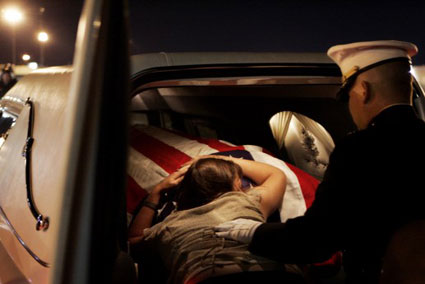
That said, I was particularly taken with the reaction to yesterday’s post by Chris Maynard, titled Final Salute (link).  Chris was looking at the award winning photo narrative by Todd Heisler of the Rocky Mountain News of a young widow whose husband died fighting in Iraq.

The readership brings up an important point — one I hope can be discussed further here.  The issue involves the politics of empathy.

The question is, to what extent do Heisler’s powerful photographs make the war more “felt,” yielding greater political consciousness and a broader sense of humanity, and to what extent to do they sentimentalize a war that never should have happened and overshadow/marginalize/disappear a far greater number of Iraqi losses (each full of pain certainly commensurate to that of this widow’s)?

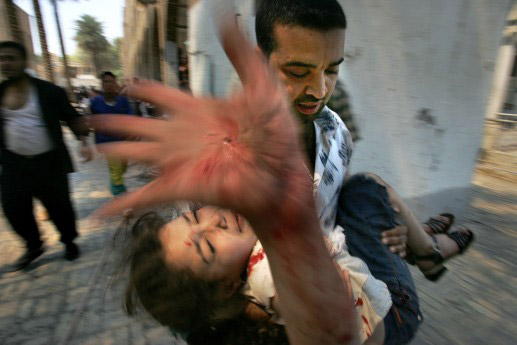
Because The BAG posts specific images for their specific content, and almost never for their illustrative value, I was a little conflicted about offering you another World Press Photo winning picture in response to the Heisler shots.  Still, given the fact we’re considering this one collection, I thought I would complicate the discussion by offering this image, by photographer Scott Nelson, as a something of a parallel.

This shot, taken May 7, 2005, shows an injured girl being carried from the scene of a suicide car bombing.  According to the caption, the explosion in Tahrir Square in Baghdad killed 22 people and wounded more than 35.  The target of the blast was a convoy of civilian contractors.

There are a thousand nettling questions to ask in considering this picture — and in comparing Nelson’s series to Heisler’s.  Here are just a few:

Given that Nelson’s work earned an honorable mention and Heisler’s won a first prize, were Heisler’s pictures simply more powerful?  And if so (and the difference is not just culturally subjective), how does one reconcile the culture gap and disparity in access when it comes to the creation of intimacy?  And then, when that gap exists but we’re hardly aware of it, how do we account for the difference between who is more badly pierced?


(image: Scott Nelson/World Picture News. worldpressphoto.nl)

  • Tina

    I’m sure you had a multitude of thoroughly tragic photos to choose from. I don’t envy you the task of having to select one as a counterweight to the previous thread.
    My first reaction was to realize how accustomed I have become to these types of pictures. I looked it over and thought:
    “okay, what’s special about this one?”
    I’ve seen so many anguished faces and waving bloody limbs over the last few years I don’t really know any more. I really don’t.
    Does it also have something to do with her being Iraqi? Or am I just desensitized in a general pictures-of-Ethiopean-famine-victims sort of way?

  • lytom

    There is something about Todd Heisler’s series of pictures “Final Salute.” The portrayal of grief, sanitized from the blood and gory. His writing has the power to draw you into the unknown, the mind of the person in the picture. That is powerful projection of one’s self into “what if…”
    Scott Nelson’s series are “from there.” Bloody, painful faces, and chaos.” Why can this go on and on? There is something missing from the captions underneath the pictures! The people are anonymous, there are no personal identifications, only numbers and dry descriptions. Unless we can identify with the people in the pictures and project “what if…” they will bleed alone.

  • John Hoffman

    I am an Air Force veteran, and while I was assigned to KI Sawyer AFB in Upper Michigan in the autumn of 1969 I drew funeral detail for a young soldier killed in Vietnam. There were eight of us in the detail, and after an hour of practicing saluting and folding the flag, we got on the blue Air Force bus to ride to Escanaba.
    We arrived at the funeral home in a older part of town, and brought the coffin into the chapel. The soldier’s young wife, parents, family and friends were there, and they were all visibly suffering. After the service, we loaded the coffin into the hearse and rode out to the old cemetery on the south end of town, out by the airport. We carried the flag-draped coffin from the hearse to the side of the grave. The officer in charge of the detail presented the flag to the soldier’s widow, and she started to get up, and then fell to the ground screaming and crying. She was escorted back to her car, and we stayed with the coffin until it was in the ground.
    The ride back to the base was very quiet. A couple of months later, I was sent to Thailand for my year’s peripheral involvement in the Vietnam War before getting out of the Air Force. It’s been thirty-seven years, and the funerals never seem to get any easier for anybody who’s involved.

  • oliviacw

    What lytom called projection, I would rephrase as “identification” or “empathy”. That is to say, being able to look at the picture and think “that could be me/someone I know.” In actuality, could any of us be caught in a bombing? Probably. But it’s pretty remote from our ordinary lives. However, a young woman, pregnant, in a funeral home? Any of us could easily be there (or as near there as biology permits).

  • martin

    Is it at all possible that there is a ‘currency of grief’? incremental? absolute or, worse still, exponential: that league tables might allow us to not only produce ‘a measure’ of pains inflicted, but that linear choice will have an impact (sic) on decisions in/of the future?
    I hope not.
    Having scene this debacle increase over months and now years,commonality seems to me centered around notions of ’security’. Although often within this site, people convey concerns, I am struck by the way that many peoples’ security seems to be being compromised/extinguished:I worry that the reason for the initial action has now become the chief threat to participants. Conscious, conscripted or simply by-stander.
    That should be major concern to those -our elected/selected folk whose salaries et al we fund. This surely is a tremendous, tremulous worry. It is for me; it ought also, to be for them.

  • PTate in MN

    Empathy has a neurological basis, iirc. Based on fMRI studies, when we look at a sad face, the same areas of the brain become active as if we ourselves were experiencing the sadness. Look at a fearful face and you experience fear. When you watch people dancing, the motor areas of your brain become active, and your foot starts tapping. And so on.
    Americans were horrified by this 1972 photo from Vietnam: Little Phan Thi Kim Phue flees from a napalm attack. The terror on the faces and bodies of these children is what communicates terror to us–our reaction is visceral, out of consciousness, unintentional, automatic.
    In that context, is Heisler’s picture more visceral, intimate, more likely to provoke empathy? I am not sure how to compare scenes from a military funeral with images of fire, blood, people running from a car bombing. Two things that might be determinants of intimacy occur to me:
    First, in the one case, the lens focuses on the reaction of a single person (more intimate) and in the other, we are observing an event (less intimate). Second, the physical setting of the story is familiar to us in the Heisler image–the car, the cloth of the uniforms,flag, funeral home, TV’s flicker, coffin (more)–and in the Nelson photos the physical setting is unfamiliar (less).
    I am struck when I travel with how photography captures only the sensory dimension of sight. The sounds, smells, the way the air feels, or the flavor –say–of dust on your tongue remain hidden until you travel to that place yourself. I think that sensory disconnect also plays a role in intimacy.
    So what I see in this image is a wounded child being carried. I see her bloodied hand and a blur of motion in the people nearby, but the images stay cognitive. I know the bad thing that has happened, the car bombing, and I have instinctual dread of bloody anything to disturb me. But I have more distance on the event. A couple of the other Nelson pictures strike me as a bit more physical-the men jumping away from the burning car, for example. There I jump away with them. But even with that image, I found myself observing the cityscape–the dryness, the bricks, the trees. I find myself observing their clothing as well–some dress like me, some don’t.
    As the image from Vietnam communicates, empathy can leap across cultures, landscapes, customs. But given all the unknowns that must be bridged, such transcendent images may need a greater intensity and immediacy of feeling to overcome the unfamiliar. In addition, they may need the focus of an individual, not a group. Little Phan Thi Kim Phue was not named when this picture was first published. Because of the power of this image, years later, people identified her. They wanted to know what happened to her after this event. Viewers made intimate that which began as an event.

  • http://www.keirneuringer.blogspot.com Keir

    I don’t see how soldiers in flag-draped coffins and little girls strafed with shards of glass and metal (or whatever) are supposed to form analogues. Anyway, if I have to say, my empathy buttons are pushed not by people who volunteer to kill or die as aggressors and occupiers, but by children caught in the crossfire.

  • Doctor Jay

    The people photographed here don’t want to let us into their internal world. She holds her hand up to the camera. He bows his head and looks away. This is quite understandable, but very different in attitude to the young widow, who is shockingly uninhibited, really. She wants to share her grief with us.
    I’m not the one to say that cultural bias or skin color doesn’t affect our feelings about these photos, how could I know that? But there’s a difference in the intent of the subjects that is quite clear to me.

  • http://profile.typekey.com/browneyedgirl65/ BEG

    I agree with Dr Jay here. The one with the child packs an immediate punch. The one with the widow…the first picture it took me a while to realize she was hugging one end of the flag draped coffin. The one in front of the TV was just plain bizarre. Utterly bizarre. The one with her belly touching the edge of the coffin is the only one I consider more parallel to the iraqi one, and it’s diluted by the weirdness of the other pictures with this widow. And I think Dr Jay summed it up — one invites us to join in and the other has their private grief. And I respect the latter more. (Even realizing that the child may have just flailed her hand, nothing to do with the camera.)

  • ummabdulla

    This girl was injured in a blast in Baghdad’s Tahrir Square. Just for the record, “tahrir” means “liberation”.

  • Chuck

    This person has a chance, her story isn’t over yet. Of course, the story of a widowed spouse isn’t over, but it is over as-they-knew-it.

  • http://www.1explore.com Juno888

    I thinks this girl was shot in the hand coz her hand were have small scar or have blood cloth.. but totally as i see her she was injured…