BagNews Archives About Staff BagNews is a progressive site dedicated to visual politics and the analysis of news images.
Saturday, February 11, 2012

Twitter

@bagnewsnotes »
Advertisement


October 3, 2005

This Year’s Fallujah

Timetalafar350-1

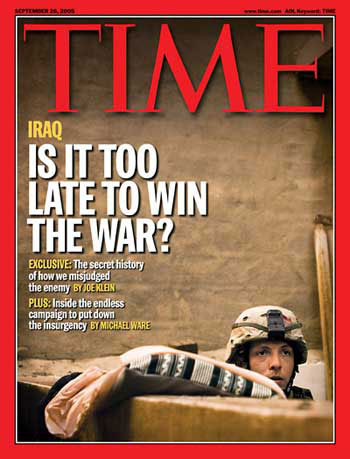
With Katrina having drowned out most other news in September, I thought it was worth taking a look back at two iconic images.

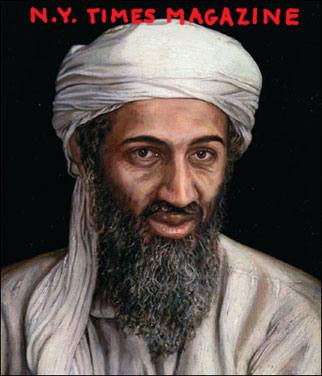
The TIME cover is from September 26th issue, but the photo itself was taken on or around September 2nd, during a military offensive in Tall ‘Afar.  The second image is a painting that appeared on the cover of the September 11th (anniversary) issue of the NYT Magazine.  (Lacking a copy of the actual cover, I added the publication title with my own lettering.)

The TIME cover was shot during a military operation in which TIME reporters were along for the ride.  If you read the cover story, three significant points are made:

1. According to TIME, the attack on Tall ‘Afar was "this year’s Fallujah."
The magazine states that the assault involved "7,000 U.S. and Iraqi
soldiers and hundreds of Bradleys, battle tanks, artillery pieces, all
combined with AC-130 Spectre gunships, F-16 fighter jets and attack
helicopters."

2. This operation was "mostly unseen, with accounts of the
fighting limited largely to the reports of U.S. and Iraqi officials in
Baghdad."

3. Whether a four day pause ordered by President al-Jafaari had
anything to do with it, the operation didn’t round up many insurgents
and was ultimately characterized as "whacking at moles."
  Nytmosama

The painting on the NYT Magazine illustrates the cover story
by Mark Danner about the way Osama bin Laden essentially got the better
of George Bush and the neocons. Danner’s thesis is that bin Laden
outsmarted us, luring the U.S. into a campaign in Iraq that would
ultimately undermine America’s "all or nothing" proposal of winning
over the Middle East to democracy. Along the way, he argues that al
Qaeda turned itself from an organization into an ideology characterized
by an opposition to U.S. interventionism and American support for
authoritarian Arab regimes.

My sense is that September was a turning point. The Tall ‘Afar
photo (with the small, young soldier’s face dipping down and blocked by
an unfamilar garment, pillow or blanket) speaks to the shrinking
viability of the American military in Iraq, and how our role has become
progressively obscured by the greater political, cultural, religious
and physical landscape.

Representing bin Laden in this visual vocabulary also seems
like a definitive gesture. I can’t wait to see how BAG readers break it
down. However, you don’t get memorialized with this kind of portraiture
if your legacy remains incomplete. The Administration may want to
ignore OBL’s existence, but the fact is, bin Laden is the one who has
most framed Bush’s presidency, and so far (perverse as it may be), is
far ahead in terms of effect.

(image 1: Benjamin Lowy/Corbis. September
26, 2005. Tall ‘Afar, Iraq. Time Magazine. Cover. image 2: Painting of
Osama bin Laden by Brenda Zlamany. September 11, 2005. New York Times
Magazine. Cover.)

  • fracas_futile

    My first thought looking at the TIme photo was that the soldier was in some sort of toilet. The wall with attached basin (with a white interior) and the lid on the right. Down the toilet.

  • http://homo101.blogspot.com Roy E Pearson

    Bring ‘em home alive in 2005.
    Not much more to say than that.
    For all the words there is only one reality they only thing that will happen if we stay is more of our soldiers will die. Can anyone say any more that we must stay to keep from looking weak? How much more impotent can we look?
    We Got in and declared Mission Acomplished in days, we can get out in the 90 we have left in 2005.

  • black dog barking

    The soldier image has definite “neck deep in the Big Muddy” overtones.
    The OBL portrait is black, white, and OBL. Don’t imagine he’d have any trouble answering Cindy Sheehan’s question.

  • Marysz

    The soldier on the Time cover is alone, disembodied and on the verge of being out of the picture altogether. Doesn’t this represent the way American soldiers are being treated by Rumsfeld and the Administration? US soldiers are being left to fend for themselves in Iraq. Their families have spend their own money to provide body armor for them. No wonder this poor soldier is crouching and trying to keep out of sight. He looks young and frightened. His country has left him alone and unprotected.
    On the other hand, Bin Laden’s gaze shrewdly confronts his American viewers. It’s an in-your-face portrait that exaggerates Bin Laden’s non-Caucasian features–brown skin, thick lips, “kinky” hair. Bin Laden here is the racialized Other.

  • http://www.keirneuringer.blogspot.com Keir

    It strikes me that both magazine covers miss the point. The Time cover suggests that its question is one that there is an answer to, and that “winning” would somehow be a positive outcome. I think it was Terry Jones (of Monty Python) who wrote in The Guardian in late 2001 or so something to the effect of “Bush has declared war on an abstract noun!” We have nothing to win and everything to lose in Iraq (and in all such adventures of naked aggression).
    As for the NYT cover, again there is this suggestion that bin Laden is some sort of omni-powerful über-villain. If things were that easy, then defeating symbolic über-villains like “Stalin”, “Hitler”, “Saddam” and so on would have solved the problems they presented to the world. But I think power-lust, fascism, racism, unchecked militarism, and sadistic state violence are still dangers we must contend with. Right?

  • PTate in MN

    I guess I have a dirty mind. The flesh colored thing–the blanket or cloth bundle–reminds me of a impotent phallic symbol. Ah sunflower, weary of time…
    As others have noted, the soldier in the Time cover is alone, he’s behind a wall, he looks vulnerable, he’s ducking down.
    Not images of power, huh!
    OTOH, OBL just looks cagey.

  • http://www.lananfrank.net/lana/ amanuensis

    On the Time cover, the soldier is neither offensive or defensive. He’s alone and out of place. You’d expect him to be popping up from a tank or a bunker. Instead, he’s hiding and surrounded by everything Iraqi.
    Text: endless, misjudged, “the war”
    If the picture wasn’t damning enough, the text reinforces it. There is no positive view here. And the war is “the war” with “Iraq” being demoted to the small type. It’s not really about Iraq anymore, is it?
    And we have “the enemy” and “the insurgency.” We don’t even have a proper noun for the ones we’re fighting, do we?
    What is the soldier doing there, again? What are we doing there, again?

  • Martin

    Here’s a weird take: On the Time cover, the pillow thing looks like his arms, to the point that that was my first reading of it. Imagine the picture (and his dejection) if the pillow is his arms with the hands at left.

  • readytoblowagasket

    From the TIME article: “Displace, displace–they got our position!” Getting our position is not hard to do, obviously, since anything with a pattern stands out like a neon sign flashing “Hey, I’m over here!” against that deadly neutral background. The soldier has no choice but to hide behind the very thing that attracts the eye. And there’s no way out–he’s trapped, back to the wall, cornered. He shouldn’t be there, he clearly doesn’t belong there. He will not make it out of Iraq alive, and we lost this war before we even started it.
    Juxtaposed with the NYT Magazine cover painting AND filtered through a post-Katrina sensibility, I see “scared white boy” vs. “powerful black man” in these images.

  • hauksdottir

    It was never possible to win a war against a noun. It never has been. Have we won any wars against poverty or illiteracy? So we go from city to city, flattening it, and leaving it to the families mourning their dead and vowing revenge. If we can’t take and hold even a single city and we can’t find the enemy to engage him… what are we doing out there in the desert?
    http://www.guardian.co.uk/worldlatest/story/0,1280,-5315277,00.html
    Bush didn’t care what his advisors and lawyers said, HE thinks of himself as dictator and what he thinks goes:
    “According to Clarke, the president yelled, “I don’t care what the international lawyers say, we are going to kick some ass.”"
    http://www.scoop.co.nz/stories/HL0510/S00039.htm
    Even as Iraq crumbles into civil war, the politicians murder each other, torture and beheadings are commonplace, the recruits prove to be spies for the resistance, and our soldiers wither under futile orders to play whack-a-mole on sand… brave Bush seems to be ignoring one key point. That Iraqi army is less strong than it was 3 months ago. It went from a brigade and a couple of battalions to one battalion… and not one of the ones which had already been designated as combat-ready.
    President Bush said he was encouraged by the increasing size and capability of the Iraqi security forces, touting progress on a key measure for when U.S. troops can come home.
    “They have made important gains in recent weeks and months; they are adapting our strategy to meet the needs on the ground; and they’re helping us to bring victory in the war on terror,” Bush said Saturday in his weekly radio address.
    “The Bush administration and the military have pinned success in Iraq on the development of an Iraqi army to take the place of U.S. and coalition forces. The United States is training 107 Iraqi army and police battalions and, until Casey returned this week, three had been rated as Level One, or “fully capable” of acting on their own without U.S. support.
    Casey told Congress that only one battalion is now rated as fully capable but said that should not be viewed as a setback.”
    http://www.thehill.com/thehill/export/TheHill/News/Frontpage/100405/casey.html
    If we can’t come home until the Iraqi army is ready to stand on its own… why are we building forces of sand which blows away in the first gust of wind?
    Why are we building 14 permanent bases in somebody else’s country?
    And, glory be, Bush’s latest pick for the High Court is somebody who thoroughly understands the “GWOT” and will work hard to ensure that the Court doesn’t get in the way of the military efforts to subdue the world, one city at a time… or Halliburton’s war profits.
    The utter futility of it all!
    Carolly

  • http://www.thenewpolitics.com Chiaroscuro

    I immediately recognized the Times Magazine cover painting as taken from a memorable portrait photograph of bin Laden.
    I’m not sure that the magazine cover painting is exaggerated enough to classify it as a thinly-veiled evocation of racism, as suggested above. I do think, however, there may be a subtle attempt to provoke unease and disorientation with the image of bin Laden.
    The painting has flipped bin Laden’s face from the original photograph. He now gazes right instead of left. We can’t know whether that was the choice of the painter or the art director, the latter believing that leading rightward into the body of the magazine was better compositionally. Since faces are not perfectly symmetrical, the effect is strangely “off”. We know it’s bin Laden but it’s not quite him as we know his face.
    In both the painting and the photograph, bin Laden appears about to speak. The lips are exaggerated from the original. Whether this is an attempt to convey “otherness” or sensuality (which would be ridiculous, given what we know about bin Laden), is debatable. The painted eyes are also not quite right, but slightly lopsided and wall-eyed.
    Again, since this is a painting taken from a photograph, it’s difficult to determine what is a conscious choice by the artist or merely poor technique.
    I do think the aging of bin Laden–the sallowness, sagging and added wrinkles compared to the original photo–is deliberate. This could be interpreted as added gravitas or degeneration. I suspect the latter.
    The switch from a warm golden background and skintones in the photo to the overall grayness and dark background of the painting certainly makes the subject appear more ominous.
    The question seems to be: Why commission a painted portrait of bin Laden when there are any number of good photographs? Does going with a painting somehow mythologize the subject? Does it remove bin Laden one step from immediate reality?
    Objectively speaking, bin Laden is a physically handsome man. The disparity between the warmth, intelligence and seeming kindness of his facial features and the cold, calculating murderousness of his beliefs and career is extreme. The painting seems designed to evoke the inner, rather than the outer, bin Laden.
    Perhaps the editors of the Times Magazine decided to drag Dorian Gray’s portrait out of the attic and onto their cover.

  • readytoblowagasket

    Ha! After reading Chiaroscuro’s comments and studying the NYTM cover again, another association just came to mind: TIME’s annual Person of the Year cover (often an illustration), which is what the bin Laden cover looks like here. So another question is, did NYT intend that association? Is Osama bin Laden the Person of the Year for 2005?

  • blythetdm

    The soldier as the US military: overwhelmed by its environment (he takes up about 15% of the cover); alone, anxious, fearful, semmingly paralyzed.
    The abandoned (garment? – the flesh tones appear to be a collar or maybe the lining of a jacket) as the Iraqi army – an empty presence in the war.
    The meaning: We are sinking deeper and deeper in the pit of Iraq, by ourselves, in almost above our heads.

  • Megan Rose

    The portrait of Bin Laden immediately made me think of Emmanuel Goldstein, from 1984.

  • http://john-norris.net John Norris

    There mere fact that someone took the time to do a realistic painting of OBL, probably not often seen in the west, adds depth to OBL’s character.

  • http://profile.typekey.com/sardonicus/ sardonicus

    I can’t remember when the bin Laden photo that chiaroscuro refers to first made its appearance, but my recollection is that it was probably some time after the U.S.S. Cole bombing, when he was a known name but not yet a household word. Previously, all the images I’d seen were blurry vid-caps.

    As chiaroscuro observed, it’s a memorable picture. My own reaction the first time I saw it was “That’s a hell of a shot. He looks like a rock star. The media must have big plans for that boy.” Which is ironic, in view of subsequent developments.

    The change reminded me of the switch that the media made with photos of Jon-Benet Ramsey. For a long time, the standard photograph of her was this one. When the media finally decided to treat her as a child victim rather than a child vamp, they switched practically overnight to using a different image. The almost universal switch from the poor quality vidcap to the ‘rock star’ photo as the standard representation of bin Laden made me wonder if we weren’t seeing a similar shift in the story that the media wanted to tell about bin Laden.

    Post 9/11, the standard image changed again, and we were back with a blurry vid-cap. It wouldn’t be appropriate to have America’s public enemy number one looking like a soulful Sufi sensation from a world music album cover. The vid-cap is much less flattering and more menacing. It also removes any temptation to romanticize UBL or even consider him as vaguely human. Ironically, it also means that anyone who can put on a white hat, a combat jacket and a fake beard can issue their own bin Laden videos, because the standard for likeness has slipped so far.