BagNews Archives About Staff BagNews is a progressive site dedicated to visual politics and the analysis of news images.
Sunday, February 12, 2012

Twitter

@bagnewsnotes »
Advertisement


July 19, 2005

Drummed Out

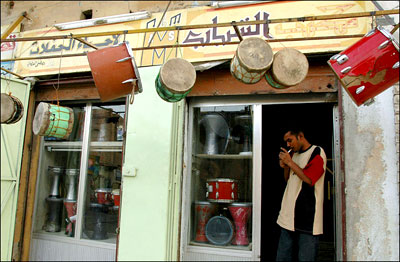
Basradrums

Although this music store in Basra was there as of two weeks weeks ago, it’s possible it no longer exists. 

If you’ve been following the BAG, you know we’ve had the good fortune to have images, correspondence and also discussion participation from Alan Chin.  Alan is a prominent photojournalist who has spent the last several months in Iraq.  Toward the end of his most recent trip, he was in Basra shooting pictures for the NYT with one of it’s reporters.

Last time I checked, George Bush was still standing by his third (or maybe fourth) rationalization for the Iraq War, which was to bring democracy to the region in the form of a secularly-run Iraqi state.  As Alan’s account illustrates, however, this ideal is quickly being drummed out in southern Iraq, as evidenced by the influence of Shiite fundamentalists, and growing ties to Iran.   

As a poignant symbol of cultural repression, The NYT article that accompanied this image describes how music stores have been targeted for harassment and attack.  In correspondence with the BAG, Alan provides his own details, as well as some background to the photo:

My sense of the growing religious atmosphere in Basra is essentially
that of [the Times reporter]. It is very true that women told us how
they were told to cover up whereas before they did not have to. And
even early on in 2003, liquor stores were forced to close down. Right
now it’s probably impossible to get alcohol in Basra, whereas it’s
relatively easy to do so in Baghdad.

It’s also true that posters and photos of Sistani, Hakim, Khomeni of
Iran, and other prominent Shia figures past and present are on walls
everywhere.

The city is also very dirty (more so than Baghdad) and the
electricity is very erratic, and in general it is a poor place. So the
much-touted British approach, and Shia rule, haven’t done enough in the
way of providing and improving services. But the one success, a
meaningful one, is the far better security. In such a Shia city there
is no "sea" for insurgent "fish" to swim in. So there are no blast
walls and barbed wire, a far less visible police presence than in
Baghdad, and the populace is far more relaxed as they go about their
daily lives.

The caption to this photo stated that the store had just been
bombed.  The BAG asked Alan about the motivation for the attack and the
circumstances of his visit:

[The shop owners] believe that it is the Moktada al-Sadr extremists
who have been attacking them. The idea that music is un-Islamic, is
comparable to the Taliban who had similar ideas about music, dancing,
and other such pleasures of the senses. Also they told us there were 10
music stores before but only 3 now. So the store might close down if
they are attacked again.

The part of the store that was bombed is actually next door, to the
right.  There wasn’t much to photograph there because the guys had
cleaned it out and had started re-plastering the walls. So this is
after the bombing but not the part that was damaged. We didn’t stay
there long because our driver spotted some sketchy guys down the street
who started making cell-phone calls as soon as they saw us, and the
other people on the street were nervous and anxious rather than curious
as they usually would be in a safer neighborhood.

I think [the guy in the doorway] is one of the musicians.  This is just how I found him. 
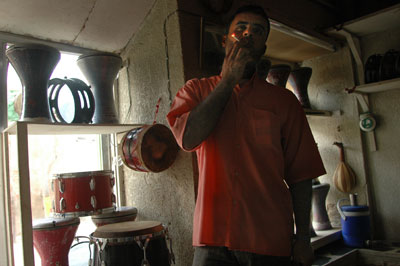
Chindrum2

 Although, as Alan describes, he was in and out pretty quick,
here is another shot from inside the store.  It’s dark because the
power had gone out (which was a customary occurrence).   

From a strictly visual standpoint, I find these images quite
evocative.  (Of course, if I was a musician in Basra right now, I’d
probably be doing a lot of smoking as well.)  The hanging drums,
though, are an affecting symbol.  It’s hard to look at a drum without
feeling the urge to strike it or imagining it’s vibration inside your
chest.

As an elemental instrument, the destruction of a drum seems like the greater sacrilegious act.

 (image 1: Alan Chin. July 7th, 2005. Basra, Iraq.  In nyt.com.  image 2: Alan Chin. July 7th, 2005. Basra, Iraq.)

  • cj

    My first impression of these photos is defiance. In the top photo, the drums appear to defy gravity (even the damaged red one on the right)–the gravity of the situation in Basra. The guy in the doorway seems to have a defiant attitude–ala James Dean–apparently cool under the circumstances….. In the second photo, he seems a bit more contrived as if to say–show them this one. He may be intending defiance, but the glow of the cigarette seems as much like the fuse of a bomb or dynamite as anything else–is it just a matter of time before…..?
    Alan: Good to hear from you again at the BAG! Did you at least get a chance to bang on a drum a bit…..?!!!
    cj

  • bg

    Beautiful photos. The storefront is among the most colorful and nearly joyful we have seen from Iraq any time recently.
    I recall reading about Afghanistan, in the early stages of the Taliban “intermission,” that the first thing the people did was to get out their radios and blast music from home and street.
    And so the undertone of these photos is the coming darkness of religious oppression. . .Music forced indoors, undercover.

  • mugatea

    Music is such a common language between us all.
    It’s such a part of my life that this post was hard to take. People in music stores are some of the most peaceful. The drum has been with we humans since-???????
    I’m taking my drum outside and bang some rhythms for our friends in Iraq.

  • MonsieurGonzo

    i agree that these are lovely photos, but i fail to see how either of these images illustrates the threat of fundamentalist terror, or burden of foreign occupation ~ that this place / these people are experiencing. rather, imho they emote innocence and perhaps, naivete.
    i mean, latest (wire service & personal blog) reports out of IRAQ are telling us that iraqis are barricading themselves in their own homes; blocking off their streets to prevent vehicle access; and, activating their secular, heavily armed militias ~ iow, they are just a hair-trigger away from all-out civil war :-/
    meanwhile, women are being almost entirely cut out of the new Constitution; it is almost impossible to see them in public now; and besides the criminal (robbery / kidnapping / rape) threat, women in iraq who do venture out are facing de facto “morality police”, where not only public humiliation but also real beating is happening (including, we read ~ having acid thrown in their un-covered faces)
    these images reflect none of this… horror.
    there is no sense here of vulnerability; ie., impending threat = “urgency”, defensiveness or desperation in these images…
    …were it not for the pleasant, personal text context provided by the photographer / our narrator: frankly, i would have dismissed these images as “sanitized” occupation propaganda :-/

  • Quentin

    Monsieur Gonzo’s point is well taken: the pictures are nice but they don’t illustrate the narrator’s words. Grisly scenes of mutilated bodies and torn limbs might be more to the point. But the U.S. media find such images tasteless, disturbing, and propogate the heart-rending falsehood that all is well on the Iraqi front. Like, haven’t you heard: no coffins of U.S. military officially arrive in the U.S., they’re smuggled in after dark like contraband. When will people get it?

  • Alan Chin

    guys, this music store is in BASRA, not Baghdad. There is very little insurgent activity there because the Shia militias, who, on this hand, enforce a conservative Islamic social order, on the other hand, keep the city safe. Basra, unlike Baghdad, has a bustling street life, has no blast walls or barbed wire surrounding houses and buildings, and is in most ways much more relaxed. A foreign journalist like me could walk around, albeit sensibly and without lingering in bad neighborhoods, like the one the music stores are in.
    In Basra I ate in restaurants and wandered the markets every day, whereas in Baghdad that is considered almost suicidal for a foreigner.
    it’s true that my photos here don’t show “horror” — because how do you photograph the bombing of a music store that happened several weeks before — and the damage has been cleaned up? In this case I thought the only way to approach the issue was to show the part of the music store that wasn’t hit, just so the reader gets a sense of what these places look like.
    Regarding the publication of more grisly scenes, I have on this blog before discussed how I have fought, unsuccessfully, with my editors over this issue. It is my personal opinion that, after the NYTimes ran on its front page last year the photo of the killed contractors hanging from the Falluja bridge, and they received a lot of unfair and unjustified criticism for that, that they have become more circumspect in what they print.
    Which is a disservice first and foremost to the readers, and also to the photographers and journalists who cover this war.
    Most recently, the I think that the starkest images of death from Iraq published in the NYTimes are on the website, it is the multi-media slideshow on the Baghdad morgue, with photos by my colleage Christoph Bangert and myself. I have also uploaded, on my personal web-page, photos of the violence that were not published. (www.lightstalkers.org/alanschin)

  • MonsieurGonzo

    Mr. Chin ~ thank you for your thoughtful response.
    ya gotta unnerstand, we’re takin’ these images at face value ~ sans text context; eg., there’s nothing in the frame that says, “BASRA -not- Baghdad” or, “this photo is BEFORE; man, you shoulda seen what horror happened to this guy!”
    yeah, i know it’s a high standard to tell the story, make the point via the image(s) alone…
    …but, we’re not readers, Mr. Chin: we’re viewers ;-)