BagNews Archives About Staff BagNews is a progressive site dedicated to visual politics and the analysis of news images.
Wednesday, May 16, 2012

Twitter

@bagnewsnotes »
Advertisement


March 12, 2005

Pain in Spain

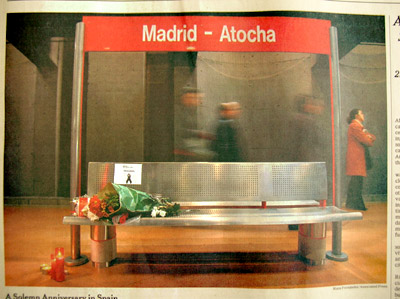
This shot, commemorating the one-year anniversary of the terror attack in Spain, is on the front page of today’s NYT.

Here is the caption:

A Solemn Anniversary in Spain.  Tributes were left yesterday at Madrid’s Atocha rail station on the first anniversary of the March 11 train bombings, which killed 191 people.  Memorial events were held throughout Spain yesterday, and King Jan Carlos and Queen Sofia led the nation in observing five minutes of silence.

Regarding the artistic nature of the photo, does the fact it’s so stylized show any more or less respect for the event? 

Looking at it more formally, I think the image presents some interesting symbolism.  In anchoring the shot, the flowers could be seen as representing the tragedy itself.  Then, you have a frame or window formed by the combination of the bench and the sign.  Inside that “window” are three people who are blurred, with the first blurred person seeming to catch sight of the flowers.  Also, you have a woman at the far right, looking up and out of the picture, oblivious to the memorial.

If there is any meaning to be found here at all, what is the significance of blurred figures inside the window?  If there is an implied editorial meaning, does it have to do with the public’s attention to the event? The extent to which they are effected by it?  The extent to which they have any control over it? 

Notice that the woman (with her back to the shrine, one might say) matches the transit sign, whereas the blurred figures (most likely, men) are effectively monochrome.  It’s completely my association, of course, but could you say that women are more likely to feel empathy without the need for the literal contact with a memorial that a man might?

What else does the image suggest?

Is this be the future of grieving, where we mourn on the go?

(image: Manu Fernandez/AP in the New York Times)

—————————–

Random notes:

>>If it looks a little wavy, that’s my camera.  Although Yahoo sometimes switches these things around, you can see the web version here.) 

  • rhondda

    For me the empty bench is the point. The woman with her back to it is just a frame as in we all forget. The blurred people could be the blurred victims. The question that comes to me is is this bench normally full of people waiting for transit?

  • http://greentuna.blogspot.com greentuna

    With the contrast of “reality” sharp vs. “artistically” blurred focus, this seems to be a very unusual picture. The blurred figures in the background strike me as ghosts of the people who used to travel through this station and ride the train as a part of their usual hustle and bustle lifestyle, but who died in the attack. Interesting and puzzling.

  • aethorian

    “Sometimes I sits and thinks, and sometimes I just sits.”
    —Anonymous

    Alicia Titus Memorial Bench
    June 11, 1973 – September 11, 2001
    Graham High School
    St. Paris, Ohio

    9/11 Memorial Bench
    Bayou Vista, Texas
    September 14, 2001

    9/11 Memorial Benches
    Montgomery County, Maryland
    September 11, 2003

    Pentagon Memorial Benches
    Arlington, Virginia
    Dedication – Fall 2006

    Bali, Indonesia Memorial Benches
    Unley, South Australia
    April 12, 2003

  • http://ibiblio.org/pyro/ramadan.html ray

    i do not know it it a southern tradition, but have you not seen those piles or funerary flowers and wooden crosses at the sites of fatal traffic accidents? sometimes these last for months and some are even kept clean. and these are obviously done by the family, not some “Memorial Fund”.
    ‘mourning on the go’, happens all the time. what about when i listen to my john peel tapes announcing his guests for next weeks show, and i know he is preparing to fly off on a fabulous holiday across the wide sea and die of a fatal coronary?
    “death is covering [all of] us like fine dust”

  • Quentin

    I’m not so sure the picture means so much: probably nothing more than that life goes on. It struck me as significant that the Spanish walked together in the streets of Madrid and other Spanish cities on the day of the bombings or shortly thereafter to reclaim their society and living space from the terrorists in a show of solidarity and compassion. In the U.S., instead, people have been cowering and bitching ever since as if what happened to them occurred outside history and human experience. Even Madelaine Albright, whom I always considered a thoughtful person, recently said in Madrid that the world must understand how traumatized the U.S. was on September 11, 2001. Maybe she needs to understand that the whole thing happened almost four years ago and since then the U.S. has traumatized more than enough people in Iraq, Guantanomo, Begram and other places in revenge for what happened in the U.S. I’m not saying that what happened was not horrible, I am saying that the reaction was horrible, monopolized by Bush and manipulated by sentimentality and opportunism. This picture is simple and reverent: the bench is an altar. The Spanish accept life in all it’s facets. They reject the Hollywood cry of pain: we will never forget. Instead maybe they say we cannot forget but we must, somehow we might even be able to forgive. No matter what, we are together. And at least they don’t have that miserable Aznar to manipulate their emotions.

  • seize

    did anyone see a video broadcast of what that 5 minutes was like? it was pretty moving, and just as simple as this photo. the reporter said people “poured into the streets” from office buildings, churches everywhere rang their bells, the trains stopped. a dedication of the “forest of the absent.” piles of candles, flowers and notes in subway stations. and then everyone burst into applause. because that’s what people do in spain after a funeral.
    the trains started back up. on the same train that was hit a year ago, people just sat in silence.
    i love this photo. it was to me a signal that people cared, let memories on the altar, but had to move on, too. at 12, everyone stopped. and then we move not on, but with it, cause they can’t forget 3/11.
    and speaking opportunism, we musn’t forget that 3/11 had its own political seizing of its own. just because we might agree with their actions doesn’t mean you can ignore the political impact of an event like this.

  • MonsieurGonzo

    “…the bench is an altar” -Quentin
    “…The blurred people… victims [ie., spirits]” -rhondda
    the solitary, counter-facing woman, survivor(s), thus.
    we (the viewers) are a congregation en masse.
    (the photographer/artist, our spiritual conduit ;-)
    “i love this photo. it was to me a signal [solemn ceremony] that people cared [of global bereavement]… [our flowers / love offerings] memories [rest] on the [cold steel] altar…
    [ie., the torn and twisted train, re-incarnate]
    …at 12.00, everyone [left behind] stopped… …but [despite our sense of overwhelming loss, loss of life, loss of innocence since 3/11 ~ we all must] move on, too.”
    the blood red train to Madrid ~ rises up, born again from its torn and twisted remains; now an altar to the spirits gone but not forgotten ~ it is ready and waiting to take us to an unknown tomorrow…
    …all aboard.

  • Quentin

    Looking back, we can now see we’ve been on board this train for much longer than we’d ever thought.

  • http://www.afn.org/~afn29467/ Maurice Sarns

    It definitely reveals the differences between US and European preparedness for the realities of securing against terror.

    I suspect Europeans would react with anxiety rather that pathos to a picture of an abandoned package in a train station.

    We aren’t there yet.