BagNews Archives About Staff BagNews is a progressive site dedicated to visual politics and the analysis of news images.
Friday, February 10, 2012

Twitter

@bagnewsnotes »
Advertisement


March 8, 2005

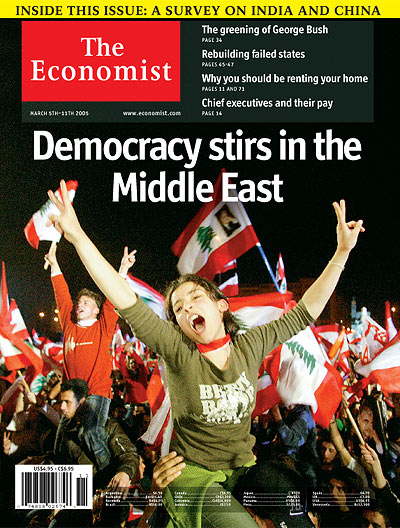
Betty Boop Takes Lebanon

20050305Issuecovus400-1

If you’ve been following the Lebanon story, this certainly isn’t the first photograph you’ve seen of demonstrators in Beirut’s Martyrs’ Square.  I would be willing to bet, however, that this particular shot differs significantly from the majority of newswire photos you’ve seen.

If you’ve been following the BAG, you probably saw the post I did recently about The Economist’s coverage of George Bush’s European trip. (Bush Snakes Through Europe. Or: Art of Darkness - link).  In commenting on the nonsensical cover illustration, a number of you felt the image was skewed for an American audience.  One BAG reader, Pedro, even pointed out that the magazine we see in the States is actually a U.S. edition.

If it’s true that The Economist skews their covers for an American audience, I would say they just did it again.

So, what’s happening in this shot that you wouldn’t necessarily find in the typical AP or Reuters version?

For one thing, similar images don’t feature voluptuous young women
sporting shirts featuring the American movie icon, Betty Boop.  Also,
in most other shots, protesters featured on someone’s shoulders tend to
be holding at least one Lebanese flag.  Instead, this woman is making
two peace signs, a symbol an American viewer could easily claim as
homegrown.  (In fact, doesn’t the Nixon estate hold a patent on this
gesture?)

The Economist also caters to the American viewer by divorcing this
woman from the scene.  This is accomplish in a number of ways. The
young woman is so close-up, everyone behind her constitutes a
background — or a backdrop.  Also, because the woman is actually
closer to us than she is to the other demonstrators, it invites an
intimacy with the viewer (especially male ones) while setting up a
comparatively impersonal relationship to her compatriots (who are,
after all, behind her back).  And I didn’t even mention that the girl
is also facing a different direction than almost everyone else in the
crowd.

Of course, there is one other fundamental way this reveler is separated
from those behind her.  The predominant color of the "Cedar revolution"
is red.  Notice, however, that this woman (except for the token scarf)
is entirely green.  Her shirt is green, her sweater is green, and even
her jeans (if they haven’t been altered) are also green.  As a cooler
color that tends to evoke nature, the photo would also provide a
State-side audience with a warmer, fuzzier sensory experience of what
is otherwise a highly volatile situation.

(By the way, am I imagining this, or is that the face –or someone
wearing a mask — of the assassinated leader, Rafik Hariri, on the far
right amidst the protesters.  Look just directly above the hand in the
lower right corner, holding up the flag.  The Hariri figure seems to
have a bent arm, with a hand resting on his chin.  …Who knows.  Maybe
that Martha Stewart Newsweek cover messed me up good.)

So, those are the obvious elements.  However, I think the image also hits other domestic chords.

Specifically, I think the Brits are going to school on 60’s
nostalgia.  I didn’t have time to track it down, but I’m almost sure
there’s a famous shot from Woodstock (perhaps, from LIFE Magazine?)
that looks near-identical to this one.

And who can think about Woodstock and the sixties without the allusion
to free love?  Certainly, this image is full of elements which recall
what a "turn-on" the movement was.  How about the hand reaching for the
girl?  What about that expression of rapture?  How about the fact she’s
riding this guy?   (By the way, what’s that in the mouth of the guy to
the left, who has the excited guy on his shoulders?)  With all this
suggestion, what’s so interesting about this image is how the politics
reinforces the sexuality, which in turn, reinforces the politics. 

Finally, on the subject of sex and political liberation, it seems
fitting this young woman brandishes the image of Betty Boop.  As an
American icon during the jazz age of the ’20’s and ’30’s, Betty stood
for the rejection of racism, an end to the subjugation of women,
economic and social justice, and also a defiant break with victorian
morality.  As you look at this picture, Betty is George’s ally.

That said, I just hope somebody has the courage (maybe those wild
daughters of his) to tell George democracy can’t flower without flower
children.

(image: The Economist)

  • aethorian

    The same picture is apparently on the North American and European editions.
    At first glance, it’s in the same class as this emotional appeal, and seems heady for a magazine titled “The Economist” (compare the rather sedate look of their home page). The text of the article hopefully provides a more thoughtful view.
    As far as grabbing attention at the newsstand, it’s a great cover. Enthusiastic young face (what do her parents think about things?); attracts the eye of (mostly) male readers; complementary green and red colors (echoes the magazine logo, too); excitement and strong action; and symmetric composition (couldn’t have allowed for the headline any better than if it was posed). From an editor’s standpoint, what’s not to like?
    First there’s the cheering and flag waving, but later there’s the …?

  • Quentin

    Is she an actress or a model? It wouldn’t surprise me, the picture seems too succesfully geared to the message of sex and country. The head of the man holding her up is between her legs, vaguely visible, with face turned down, it seems. Everyone in Martyr Square looks like they just arrived from Los Angeles, or is that only my imagination? In a comparable picture in local newspaper a young woman dressed all in black and wearing, of course, a black baseball cap stands stretched up right in the middle of a field of billowing red and white flags in the background. Another photographer’s dream? A genre seems to have originated in Beirut. In fact, the whole happening on Martyr’s Square looks rather well orchestrated. Today Hezbollah demonstrates, the people will doubless look different, I suppose not from Los Angeles. Maybe older too.

  • Quentin

    I forgot to say the young woman in black is holding a flag, not making a victory sign. How can the Nixon estate have the patent on the sign? It goes at least as far back as the second world war (Churchill?). No matter what the Hezbollah people look like you will definitely not see them on the cover of the HOT Economist.

  • mugatea

    I’d like to know if the hand symbols meant “peace” or “victory”. I’ve seen that symbol a lot in recent years and I’m confused by it’s use. I too see peace on this cover, but I didn’t see it as peace when photos returned from that region after 9.11. I beleive the Economist is tempting the neo-cons to declare victory, when they know peace in the region is far off.
    The Economist is an English publication but subscriptions and news stand sales in the US are more than any other country they publish to/in. So they will always try to please our desires.
    I like seeing young people involved in politics, it would be nice to see our own youths expressing themselves with the enthusiasm these people are.
    Turn off your TV and get your fingers in the air!.

  • MWW

    I am really puzzled about this new meme from the Neo-Cons. It would appear the group-think of the week is “A corner has turned in the Middle East…”
    Are they talking about Lebannon?
    Even if Syria withdraws it’s troops — the largest political party in Lebannon is Hezbollah. The Syrians also exert control in Lebannon thru Syrian Intelligence Service, and thru their political allies in Lebannon, and probably also thru financial assistance to their allies. The question is – even if the troops are withdrawn … does that really mean Syria will no longer be influencing things in Lebannon.
    Or is it the Speech by Mubarak in Egypt? — I tend to suspect
    that a speech by a politician made under pressure isn’t worth spit. Did he say which parties would be allowed to run? Mubaraks government is so beholden to the United States, that Bush probably can force him to make reforms – if he keeps pushing. But if they really do have a democratic election in Egypt, there is a
    high likliehood that the Islamic extremists such as the Ikwan Al-
    Muslimeen (The Islamic brotherhood) OR even Egyptian Islamic Jihad (headed by Ayman Al-Zawahiri… which is now part of Al-Quaeda) will win the election, and the democratically elected government of Egypt will then become THE MOST anti-American
    governments on earth.
    Even many of the “moderate” opposition parties had their
    leadership and members tortured in Egyptian prisons by Mubaraks
    blatently backed US regime. They might be a little bitter about that.
    But since Mubarak understands this better than Bush, I don’t count on free elections in Egypt anytime soon. Am I missing something here?

  • Izzet

    They are definitely good at selecting their covers and you are good at analyzing them. I realized after reading this post that the reason I clicked the blogad on another blog to come here is the girl. So she certainly attracts the eye of male readers. I agree that an analysis of the pictures of today’s protests can be quite enlightening. I noticed that some articles are depicting this as a Hizbollah rally. It is true that it was organized by Hizbollah but the people are as Lebanese as the previous protesters so painting them as Hizbollah supporters firstly is just playing into the hands of the Neocons’ interpretation of the recent developments.

  • Pedro

    First of all, I don’t know if the European and American editions of the Economist have different title pages. In my earlier comment I was alluding to the fact that the Economist is more widely read in the US than in Europe.
    This new cover is somewhat odd in many respects. First of all, the lighting is all wrong. From man on the left in the orange sweater’s leg and the flag in the center of the image, it would appear as if the main source of light is to the right of the image. Ms. Boop’s right cheek (our left), however, is well lit. From the folds in her clothes and the lack of shadow in her lap, I would guess she’s being lit from above.
    The other annoying detail is in the faces in the bottom right of the image. They are small and somewhat warped and — most significantly — much lower than Ms. Boop. The warping looks like something you would expect to get at the edge of a wide-angle shot and is not apparent on Ms. Boop or her porter.
    A final annoyance is that Ms. Boop’s porter is looking to our right ,whereas the rest of the crowd seems to be surging forward, seemingly unimpressed with whatever structure the porter would have to be standing on.
    What’s wrong with this picture? Almost everything.

  • thoth

    Not to mention the HEADLINE — something “stirs” alright, and it ain’t just democracy…

  • aethorian

    The green girl against a white, black, and red background aligns nicely with color symbolism in Flags of the Arab World:

    Islam gave the development of flags a great impetus. Perhaps because Islamic strictures against human representation encouraged the development of abstract decorative patterns, it was in the Middle East that the concept of associating specific colors with individuals and dynasties developed. Muhammad, for example, adopted two flags, one white, the other black, and the caliphs who succeeded him adopted colors for various reasons associated with him. The Ummayads chose white because, tradition says, Muhammad wore a white turban; the Abbasids chose black because that was the color of the Prophet’s own banner; and the Fatimids took green because it was the Prophet’s favorite color. Later, other rulers chose red to fly over their Arabian Gulf territories.
    These four colors – white, black, green and red – are still the dominant colors of the flags of the Arab world; they have come to be known as the “pan-Arab colors,” although additional symbolic meanings have been given them by modern Arab states. Blue, brown and yellow are rare in Arab flags, and orange is nonexistent.

    One could argue that this cover actually represents the Lebanese flag, a green cedar on a white and red field (historical details here). The girl has tried to dress the part with green shirt (maybe Betty Boop was all she had in the closet), sweater, and pants, and a white and red neck scarf.
    Speaking of flag symbolism, the main variant of Hezbollah’s flag (also shown here), is a green logo — note the raised arm — on a yellow field.

  • Michael Allen

    The Hariri figure is a poster/photo carried by someone in the crowd. As to your other thoughts on the photograph, let me just add that the woman in the photograph, beside being very attractive and wearing no burqa (someone you could take home to mother), also looks westernized. Someone those of us in this part of the world could identify with. Or maybe I’m just repeating what you’ve already said but in a slightly obtuse way. Never mind.

  • seize

    I cannot even think for a second that the editors who chose this photo thought that male readers would be turned on by her pose and would thus buy this magazine. Men who are turned on by teenagers’ images aren’t who the Economist is targeting.
    The Betty Boop shirt makes sense to me since in many foreign countries American/Western icons, images and trademarks get slapped on shirts and sold. It’s not an endorsement of President Bush, a victory for Westernism, or any other cockamamie scheme you might try to push on it. It’s simply fact.
    People don’t read. They skim, unless they are some otherwise compelled to read. Good writing does that. Great subject matter does that. Amazing photos like this one do that too.
    This photo is compelling. It had contrast. It tells the story. It tells something unique about this story. These are basic, basic tenets of what good photojournalism does. I’m all for analyzing the meaning behind photos and knowing what impact they have on the viewing population. But honestly, this site sounds more and more like Chicken Little. Keeping a realist perspective is just as important on judging everything as a way to subvert our minds.

  • Winker

    I enjoy this site immensely, but I can’t help but wonder after reading the commentary and comments if there isn’t a series case of salon hyperthought going on here.
    Are you writing your analysis on what the editors have chosen or what the photographer was seeing at the time of the click?
    If the photographer, let’s be realistic with your analysis…you think he was focusing on a Luscher color palette and it’s sociology or the mere fact that, “hey, it’s a chick on a guys shoulders!! Maybe she’ll flash some tits! FREEEEBIRD!!”
    I think your analysis is somewhat superfluous.
    Finally, what the hell is Betty Boop doing on a ***PUKE GREEN*** tshirt??!!

  • Michael

    Now, check out the cover of the March 14 issue of Newsweek. The headline is “Across the Arab World: People Power.” Very similar, but different,image of a pretty young woman in the foreground, being carried on a man’s shoulders in the midst of a rally, also looking in opposite direction of the crowd behind her. The added touch is that she’s somehow backlit, creating a nice halo effect. It’s like it’s the image of the day.

  • aethorian

    Hmmm … it sure looks like Newsweek is also trying to gather male eyeballs. Here are links to their major market covers, along with their male readership demographics:

      United States

    • Total readership: 19,526,000
    • Men: 54.4%
    • Median Age: 46.3 years
    • (source 1)
      Europe (British Isles, Continental Europe, Middle East, Africa)

    • Total readership: 304,459
    • Men: 78%
    • Average age: 47 years
    • (source 1, 2)
      Asia (North, Central, and South Asia)

    • Total readership: 210,031
    • Men: 72%
    • Average age: 44 years
    • (source 1, 2)
      Latin America (Caribbean Islands, Central and South America)

    • Total readership: 81,026
    • Men: 75%
    • Average age: n/a
    • (source 1, 2)

    Now why, above all images that were probably available to them, did Newsweek editors select girl cover art — very much like that used by The Economist — for America, Europe, and Latin America? And why not for Asia?

  • seize

    perhaps, aethorian, because the news on the cover is more pertinent to more parts of their readership since, i don’t know, the news happened in hong kong?
    and that newsweek photograph looks amazing. have any of you people ever been in a crowd? that was protesting? and tons of photographers/videographers flashing bulbs everywhere? people look in different directions. and light is coming from all directions.
    and winker, that is insulting to photographers. they most certainly are looking for the best image, not for tits. and they do composite their shot, looking for color and mutliple other things.

  • DisBelief

    This tidy,red-black&green revolution is coming at us through the boob tube just after the tidy orange & blue revolution in Ukraine has cleaned up its mess. The Lebanese production is playing for us now. Both events have been choreographed by a crack team of event specialists. In Ukraine and Lebanon, westerners that speak the local language and have been sufficiently motivated can unpack the cases of identically-sized flags and wear the correct colour combination. They first organize food, water and porta-potties, then throng together spontaneously for the camera. It’s just another Extreme MakeOver. Don’t Lebanon and Ukraine look prettier? It’s too bad about Yugoslavia…all that surgery and she looks worse than ever.

  • Quentin

    A few posters are very impressed by the supposed artistry of the photo, the photographers artistic skill and excellence, which they maintain deserves respect. I stand by me first impression that the whole thing has been posed and, possibly, composed, altered, enhanced or whatever. It is revolting, as I read above or somewhere else, that these U.S. clones are considered the real face of Lebanon while in all the media the nearly half million people who demonstrated in Beirut on Tuesday are firstly referred to as Hezbollah supporters, which is not incorrect, but which conveniently ignores the fact that they are, more basically, Lebanese. Which party do the U.S. clones belong to: the pure and virtuous mythological opposition?

  • mugatea

    Yah, Quentin. The photos out of Lebanon Tuesday did not glorify the event the same way the Boob crowd was … Even though the crowd was significantly larger. A lot more photos of tanks and soldiers looking over the event than the Boops crowd photos. More shots from the ground than above the crowd and I saw no fisheye lenses used.
    Yuk.

  • Quentin

    Right, muaqtea. We see for oursleves how we can literally see the visual rip-offs the media sees fit to fool us with. Nothing new: think of the staged raising of the flag on Iwo Jima, or the reenacted hoisting of the Russian flag on the roof of the Reichstag. Of course, no sexy heroics at the demonstration of half a million Lebanese on Tuesday: those were boring Lebanese, for the Bush hot ones you have to pop over to Martyrs’ Square.

  • aethorian

    Good point about Newsweek’s Asia edition, seize. According to their Pacific Edition audit, the closest its readership comes to the Middle East is Pakistan. Still, many of the Asian countries covered have large Islamic populations.
    And why would events in Lebanon be that interesting to Latin American readers?

  • MonsieurGonzo

    fwiw, i think it’s GREAT to see a vivacious young woman in any context whatsoever having to do with the Middle East…
    imho, the whole key to defeating Fundamentalism *IS* women / women’s rights; ie., rather than killing MEN, we should be focused on liberating women.
    contrast this sexed-up Economist cover photo with the (few in number, but present nonetleless) militant / black-clad, covered head -to- toe Shiite women we see at the subsequent counter-rally; or ANY photo coming out of Iraq ~ where (most female, if not male) readers ask: ” where the hell are all the women?

  • Quentin

    That’s the point, MonseiurGonze, what is so liberating about turning women into cozy sex bombs. Why don’t they at least stop being sexist and show the hot men to better advantage?

  • Munguza

    A few observations:
    - the girl in this photo is not “voluptuous”
    - the Betty Boop on her shirt may be nothing more than a shirt advertising a local restaurant, store or something. It doesn’t look like anything available at BettyBoopstore.com.
    - The youths pictured here (students?) may just have been dancing or mugging for cameras at night during a break in political speeches. Futur, a TV station partially owned by Hariri, broadcast images of opposition protests overlayed with popular Lebanese music in imitation of “Video Clips,” an Arabic MTV-style show.
    - the intent is clearly to highlight youthfulness (out with the old, in with the new), free-spiritedness, and a contrast with orthodox muslim ideals of subservient women in abayas/burkahs (remember that opposition protesters are overwhelmingly Christian).

  • Quentin

    Very significant: ‘oppostition protesters are overwhelmingly Christian’. Lebanon was founded not even a century ago by the French as a Christian-majority country. Before that, the region was part of the Syrian provinces of the Seleucid, Roman, Byzantine and Ottoman empires, lasting at least 2,300 years. And now there is a place called Lebanon!

  • http://www.islamfrominside.com/ Irshaad

    Certainly seems to be a composite image – it’s definitely a very compelling construct although the “compelling” aspects of it may have been put together in photoshop rather than snapped live at the rally. The questions raised by such images are pervasive ones in an era where almost anyone with some basic computer softwre has the ability to alter and manipulate images at will. It really becomes an issue when news media use manufactured images(while giving the unspoken impression that it’s a straight “news” shot) to promote a particular spin or view of the news. At that point, news is in danger of becoming another type of marketing/advertising business – using images and text to market a particular spin or worldview in order to shape and influence audience perception. Not quite propaganda – but taking steps in that direction.

  • seize

    what proof do you have that this image isn’t real? who is the photographer? how about this site email or call the photographer and just ask point blank: is this real? because that’s the only legitimate way any claim by the blog’s author or commentors can make blanket statements of the media and how corrupt/unethical it is. clearly, I know of many documented cases where photos have been altered, legs photoshopped out, people cloned, etc., etc. but what makes anyone think that this photo is unreal, other than these flimsy jabs at lighting and the way she’s facing?
    i may very well be wrong about this, and if so, I’ll be the first to eat my hat. but unless anyone can give substantial proof that this isn’t a real photograph, framing all of one’s comments under the assumption that the economist is doing this or doing that is preposterous. and it’s not better than talking heads prattling on about things they don’t know the whole story on.
    and irshaad: i’ll mention this idea again. any time a news organization places a photo on its cover or frontpage, it’s making an editorial statement: this is NEWS and/or IMPORTANT. and that is one of the functions of a newspaper, to be agenda-setting, to say to a society “This is important, and this is why.”
    sorry to keep posting, but i think this issue is important and can’t just be swept off as me shilling for the economist.

  • http://www.islamfrominside.com/ Irshaad

    When I first read this posting (on the Economist’s cover), I went to the Economist’s web site and emailed them asking about the image – asking whether it’s a composite image. Hopefully they’ll respond – if they do I’ll post the response here.
    Analyzing images is not something new – it’s a fact that images (esp.cover images) are chosen or composited with great care and thought. To examine a chosen image in order to determine what message a magazine had in mind when using a particular picture is something any discerning reader should do. No one’s denying that news organizations are indicating the importance of a given issue through what they place on their cover – but the nature of the chosen image can tell a great deal about what aspect of an event or issue the magazine considers important – it can convey much information about the magazine’s worldview or its take on an event. So a magazine’s selection of an image can be useful context for reading the news that’s presented in that magazine.
    But if a cover picture is not simply chosen but actually created/composited then it indicates not so much an editorial viewpoint as a willingness to manufacture and/or manipulate perception of news and events. Perhaps this picture is simply a shot that a lucky photographer happened to capture – or perhaps it’s a composite image (we’ll only know if the magazine is willing to say) – in either case it’s still worth examining for it’s content and message, just as it’s worth examining and being aware of the content and message of written articles.

  • aethorian

    This issue of The Economist was at a local library today, and the cover certainly looks real, not Photoshopped. For one thing, the cover girl’s body has a noticeable amount of sideways motion blur that gets worse going upwards from her legs to her head (the amount of blur is much less than in the waving flags). This suggests that her image was taken at the same time, and by the same camera, as the background.
    The point is not whether this is a real photograph, or an arranged event, but the editorial usage of images with sex appeal just to catch the reader’s eye. This argument becomes stronger when you turn to page six of the same issue. There we have a second image of another young female activist, this time in a revealing low-cut blouse – link (original in color: this scan is from a black & white copy).
    One cover girl might be considered happenstance, a fortunate shot by an alert photgrapher. But the deliberate placement of another, more explicit image inside the same magazine sure makes it pretty obvious that The Economist (or somebody) is trying to appeal to something a little lower than reason.
    It’s a cheap shot, but maybe democracy is just busting out all over.

  • DisBelief

    This seems to be a professional photograph of a manufactured, pro-US publicity installation. I think it is all very professional. Not amateurish, nor youthful…slick. It’s a wrap!

  • yamamoto

    This whole “uprising” is a bit “woodstocky”. Under the concept of “permanent demonstration”, they have set up about 30 tents on the martyr square. Judging of all th wood fires and guitar playing through the night, it must have attracted a lot of hippies.
    The idea of peace here is that christians, druzes and muslims (moslty sunni) are reunited peacefully for the same cause, the independance of the country, against the predictions of the pessimists who never believed this could happen.
    And about the LA look, these demonstrators are mostly middle class, well educated people. I also suspect the american press pick the pictures where protester look like americans.
    From Beirut with love.

  • Quentin

    About the LA look, yamamoto, there were doubtless well-educated, middle class people in the Lebanese Hezbollah crowd who must have looked different. They’re not cast in the LA mold. Isn’t that what a lot of western misunderstanding of the Middle East is about: they want so much to be and look like us; or we want them so much to do that.

  • seize

    I don’t disagree that the cover is a place for a news organization to spread its editorial position. In fact, I would expect nothing less from a cover. The Martha cover in the previous post is a clear example of that. Newsweek put “Martha’s Last Laugh” in such a way that makes a statement about this story. Any headline, photo, story or quote is an editorial position, even if they’re just running it off the wire. There is no objectivity. The question now is, is it fair? And that is up for debate. To me, the photo told a different angle on what people might already think about this story to the unmotivated. “Middle Eastern country uprising” conjures more images akin to what we see as insurgencies. This isn’t that. This is youth actually being political unlike the US. This is about democracy, at least in the views of the editors. And they are not the other, which is how people view them.
    And I take issue with the idea that this is just about sex. The photo itself is “sexy” because of its news value, okay, and there is a young woman in it. But honestly, we’re not talking Playboy here. Any red-blooded male who is so hard up for the mere suggestion of teenage tittilation will not look at this image and say, I want to buy it to read about this revolution. Or say I want to buy this because there might be more tits inside. If they want tits, they buy Jugs. This is the Economist, no matter how sexy you think this girl is. As for the second image you scan, I would draw your eyeballs up from the lower half of the page and look at the words. INDEPENDANCE 05. Maybe I’m wrong about this, but wasn’t there a dance gathering during the protest? Or something like that, where these so-called hippies were dancing to prove their independence? Photographers also have a nasty habit of taking pictures of signs with misspelled words in them, either to inspire empathy or ridicule. I don’t know if either were the case here, but that photo is more than cleavage.

  • Jim HIll

    In the article, you ask: “Instead, this woman is making two peace signs, a symbol an American viewer could easily claim as homegrown. (In fact, doesn’t the Nixon estate hold a patent on this gesture?)”
    If Nixon’s estate holds a patent on the gesture, he came by it as dishonestly as he came by his political career.
    I think the gesture of making a V with the index and middle fingers goes back at least to Winston Churchill in World War II, when it was a “V for Victory” sign. (Whether it was done with both hands may be moot; I think photos of VE Day show lots of people making the sign with both hands.)
    In England, if you make this sign and point the back of your hand at someone while making it, it’s the same as the finger in the U.S.
    I once heard a myth – unverified – that Churchill made sure the back of his hand was pointing toward Berlin whenever he used the sign.
    Anyhow, to make a long story longer, I’d guess that the young lady in the photo means “V for victory” and not “Peace”.

  • hyork

    I suscribe to both the Economist and and Newsweek and when I put the two covers next to each other, I could swear that it’s the SAME GIRL IN BOTH PICTURES. Different clothes but the same face. Does anyone else agree?

  • beck

    or cloned?…
    Lebanese girls are stunning. Just take a plane to Beirut and you will see how it’s true.

  • Gojira

    The “V” sign with your back pointed at something for insult goes back to medieval times. The Battle of Agincourt to be more precise.
    You can read more about it here.

  • http://smartsex.org mmaaxx

    Good blog thanks body – brunette – legged video site – girl guy in pants mpegs – pics site – down pants red pants – pants party – red pants brunette – blonde girl i pants wear – girl pants wet legged – mpegs girl pants wet – mpegs pants – pants see through video – red pants

  • http://www.geocities.com/hysterical_woman Hysterical Woman

    Any red-blooded male who is so hard up for the mere suggestion of teenage tittilation will not look at this image and say, I want to buy it to read about this revolution. Or say I want to buy this because there might be more tits inside. If they want tits, they buy Jugs.
    I think it’s more of an unconsious thing. People (not just men) are going to associate it with sex and youth and want to buy the magazine. They don’t consiously think “oh boy, this has SEX”, but it motivates them.

  • Jenn

    I just came across the Girls of the Cedar Rev dumbed down even more for teens…
    http://www.weeklyreader.com/teens/newsweek/

  • Frank

    You people have WAY too much time on your hands.

  • carine

    i am so tired of hearing this kind of nonsense from all you people who clearly know NOTHING about lebanon. if anything, this girl is on the more modest end of the lebanese fashion spectrum. newsweek could have picked a MUCH more seductive pic if selling sex were their aim!
    i had the opposite reaction to american press coverage of the “cedar revolution”. unlike their international counterparts, mainstream american newsmedia have seemed to be deliberately omitting photos of young, unveiled lebanese girls (which, if you check out any large gallery online, you clearly have to work pretty hard to keep out!).
    the revolution is authentic, and yes, lebanese people (esp. beirutis) may look a little “LA” in general… GET OVER YOUR STEREOTYPES ABOUT THE MIDDLE EAST AND DEAL WITH IT!!

  • carine

    ps. aethorian: just to clear things up– it is a coincidence that the lebanese flag is made up of “pan arab” colors. during the french mandate, the flag was simply a french flag with a cedar in the middle of the white stripe. after independence, the lebanese understandably changed the blue stripe to a second red one, creating the flag we have today.

  • http://dailysandwich.blogspot.com/ Matt Sandwich

    Hey, Carine– are you all hot ‘n sassy like that gal in the photo? If so, would you be willing to dress up like her for me? (I actually might prefer a Betty Page shirt to Betty Boop, if that isn’t a problem.)
    At the very least, I hope you can send me some of these “much more seductive” photos of young Lebanese dolls that you mention. Hubba hubba!
    TIA, LOL! m(_ _)m

  • Maria Ramos

    This is my favret cartoon character nobodielses only mines

  • http://daktara.blogspot.com daktara

    very nice site
    from egypt